
Crypto Journalist
Anas Hassan
Crypto Journalist

Share


Aave Labs has ignited fierce controversy by unilaterally pushing a critical governance proposal to vote without notifying its author, escalating tensions over brand ownership that threatens to redefine the relationship between the DeFi protocol’s DAO and its founding company.
The hasty move, which bypassed ongoing community discussion, has been condemned as a breach of trust by contributors and token holders who view it as an attempt to control the narrative around who truly owns Aave’s most valuable assets.
Ernesto Boado, co-founder of BGD Labs and the proposal’s author, publicly disavowed Aave Labs’ decision to submit his ownership proposal to Snapshot.
“This is not, in ethos, my proposal,” Boado declared.
“Aave Labs has unilaterally submitted my proposal to vote in a rush, with my name on it, and without notifying me at all.“
He emphasized the action “breaks all codes of trust with the community” during what had been a productive forum discussion featuring valuable perspectives from multiple stakeholders.
Brand Control Battle Reaches Critical Point
The proposal at the center of this dispute seeks to transfer control of Aave’s brand assets, including domains such as aave.com, social media handles, GitHub organizations, and naming rights, from current stewards to the Aave DAO via a legally structured wrapper.
Boado’s specification demands that any party currently controlling these assets, explicitly naming Aave Labs and BGD Labs, transfer them to a DAO-controlled vehicle with “strong anti-capture protections” and legally enforceable recourse if misused.
The proposal emerged after mounting concerns that brand assets are “being used to enable private monetisation and to support products the DAO has no practical say on, and is not the main value-recipient.“
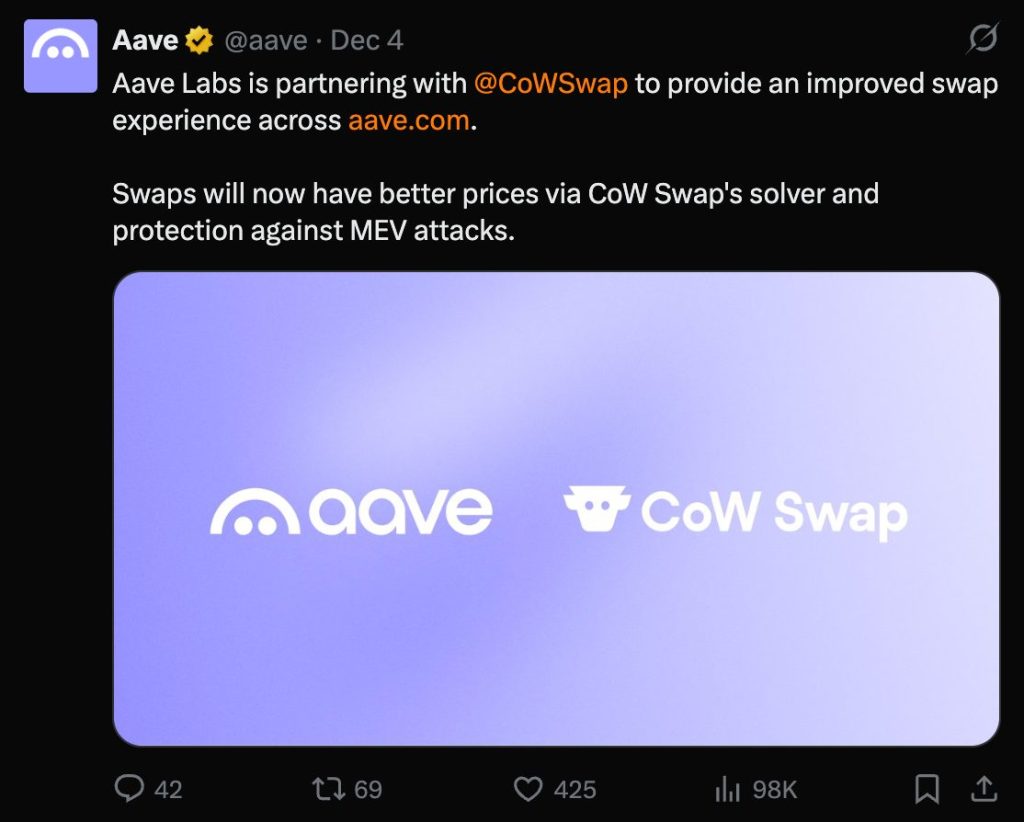
Recent flashpoints include Aave Labs replacing Paraswap with CowSwap integration, redirecting an estimated $10 million in annual fees from the DAO treasury to private company wallets.
Additionally, there’s another controversial Horizon market launch that generated approximately $100,000 in revenue while consuming $500,000 in DAO incentives.
Marc Zeller of ACI argued the DAO paid “four times” for these assets through the original LEND ICO, token dilution to the genesis team, liquidity mining programs, and generous service provider fees.
“It appears to be a clear case that the DAO contributed hundreds of millions of dollars’ worth of assets, paid in cash and tokens, making these assets extremely valuable,” Zeller stated, adding that recent communication channel management under Avara’s stewardship failed to amplify the governance debate while emphasizing “one-sided attribution” of Aave’s success.
Founder Defends Legitimacy Despite Backlash
Stani Kulechov, who maintains the title “CEO of Aave” despite the DAO structure, defended the rushed vote as procedurally sound.
“The discussion has been going over the past 5 days already with various of opinions and takes,” Kulechov stated, arguing the Snapshot complies with the governance framework and that “people are tired of this discussion.”
He claimed other service providers bring proposals to vote outside formal processes, creating no new precedent, while asserting that “the way to resolve this issue is simply to vote.“
The defense rang hollow for many observers.
Crypto educator Duo Nine characterized Kulechov’s actions as showing he’s “not acting in good faith anymore, too much conflict of interest.”
Industry analyst Ignas also drew parallels to Uniswap Labs’ similar equity-token conflicts, which ultimately resolved in favor of token holders through the removal of front-end fees.
The clash exposes fundamental tensions in DAO governance when founding teams maintain private companies alongside supposedly decentralized protocols.
While Aave Labs draws sharp boundaries between “protocol” components governed by the DAO and “product” layers it claims ownership over, critics argue this distinction enables value extraction from the brand recognition the community collectively built.
The controversy erupts despite recent regulatory wins for Aave Labs, including securing MiCA authorization to offer regulated stablecoin ramps across Europe and the SEC dropping its four-year investigation following what the company described as a “significant” defense battle.
The lab is also preparing for Aave’s upcoming V4 launch, which is explicitly designed to move complexity into abstraction layers where UX control determines value capture.
With voting now live despite the author’s objections, the outcome will determine where the community goes from here.