Flora Druryand
BBC Indonesian
The death toll in the floods which struck Indonesia last week has now climbed to more than 500, with rescue workers still battling to reach affected areas.
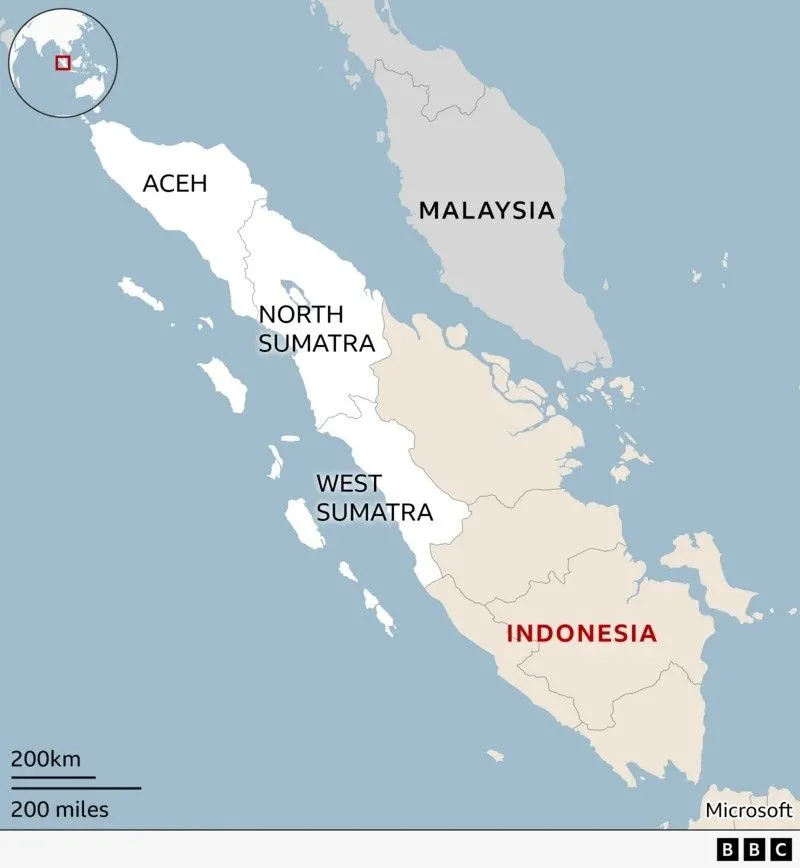
The floods, which were caused by a rare cyclone that had formed over the Malacca Strait, have hit three provinces and impacted some 1.4 million people, according to the government’s disaster agency.
Another 500 people remain missing, while thousands more have been injured.
Indonesia is just one part of Asia which has been hit with torrential rain and storms in recent days, with Thailand, Malaysia, and Sri Lanka all also reporting deaths.
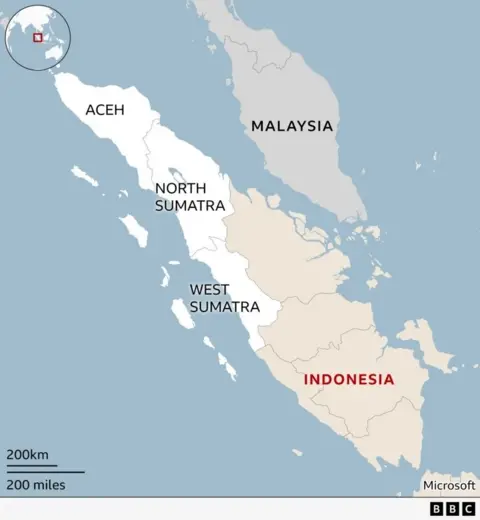
In Indonesia, the provinces of Aceh, North Sumatra and West Sumatra have been hardest hit, with thousands still cut off and without critical supplies.
Arini Amalia, a resident from Aceh’s Pidie Jaya Regency, told the BBC the flood waters had been “like a tsunami”.
“According to my grandmother, this is the worst, the worst in her life,” Amalia said.
Aid workers have been trying to reach people on foot and by motorcycle, as many roads are impassable to larger vehicles.
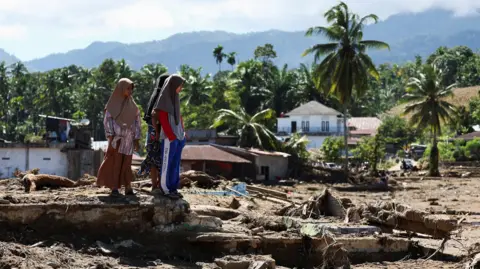
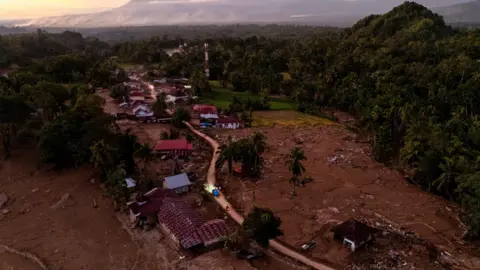
Pictures from the region show bridges washed away, roads covered in mud and debris, and logs piled high.
At West Sumatra’s Twin Bridges landmark, where flood waters swept through and deposited enormous amounts of mud and debris, Mariana watched as excavators cleared the roads, hoping they would find her missing family members including her 15-year-old son.
“Watching the excavators, seeing how thick the mud is… I keep thinking, what condition will my child be in when they find him?” she said. ”Will he still be intact? My mother, my brother-in-law… Looking at how it is here, maybe their faces won’t even be recognisable any more.”

 Reuters
Many are still waiting for food aid, with some saying they have not eaten for two to three days.
Maysanti, who lives in Central Tapanuli which is one of the worst-hit areas in North Sumatra, told the BBC that aid workers were having trouble reaching her district.
“Everything is gone; our food supplies are running out. We can’t eat,” she said. “Even instant noodles are being fought over now. Our food is gone; we need food and rice. Access to us is completely cut off.”
She said she has to walk kilometres away from her house to get an internet connection and basic necessities, like clean water.
In Central Aceh where local authorities have provided Starlink devices, thousands were seen queuing outside the regency’s office on Sunday night hoping to contact their loved ones or charge their mobile phones.
“It’s been five days with no signal. We’ve been waiting since yesterday in case the network comes back. I’m planning to call my mother in Banda Aceh, but until now I still can’t reach her,” said one resident called Mar.
As rescue efforts continue, anger has started to grow towards the government’s disaster response.
Critics say that authorities were ill-prepared for the floods. Some have blamed bureaucratic red tape for slowing down the distribution of food aid.
On Monday, President Prabowo Subianto – who was visiting some of the flood affected areas in North Sumatra – acknowledged some roads were still cut off, but added “we’re doing everything we can to overcome difficulties”.
“We face this disaster with resilience and solidarity,” he continued. “Our nation is strong right now, able to overcome this.”
 Reuters
Across South and South East Asia, about 1,100 people have been killed in the last week in flooding and landslides. In Sri Lanka, some 355 people died, while in Thailand the death toll has reached at least 176.
However, there is no single weather event that has caused the floods. Instead, a combination of weather features have been to blame.
According to BBC Weather, one element is the north-east monsoon, which affects East and South Asia from around November until March.
As the name suggests, it brings north-easterly winds, which deliver a lot of rain to coastal areas exposed to this monsoon flow as moisture is picked up from the ocean and deposited over land.
In Sri Lanka, the rainfall has been significantly enhanced by Cyclonic Storm Ditwah, which became very slow moving, delivering over half a metre of rain over a few days in some locations.
That storm has now weakened and moved away northwards to bring rain in south-east India, with the forecast for Sri Lanka looking much drier over the coming days.
In the Malay Peninsula, Sumatra and southern Thailand, Cyclonic Storm Senyar had a similar effect, enhancing the monsoon and delivering more than a metre of rain in some places. This was a particularly rare storm, forming unusually close to the equator where cyclones do not normally develop.
In Vietnam, the last few weeks have been exceptionally wet, with the monsoon rains having been enhanced by tropical cyclones. Now the remnants of ex-Typhoon Koto are drifting towards the Vietnamese coast, threatening more heavy downpours and further flooding.
It is likely that climate change has also had a part to play. While global warming is not expected to lead to more tropical storms and cyclones, those that do occur have the potential to be more intense – with heavier rainfall leading to more flooding.