Paul MellyWest Africa analyst

 AFP
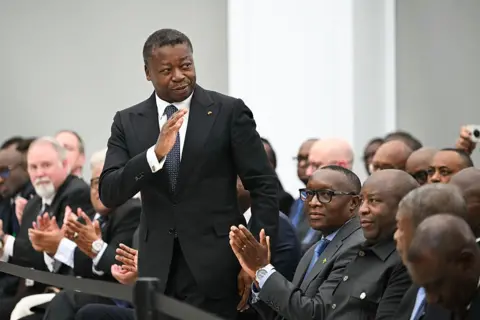
AFPWhile some West African nations are choosing to cement old ties with France and others cultivate a new relationship with Russia, one country is trying to have the best of both worlds.
As the 7 December attempted military coup in Benin collapsed, the rebels’ leader, Lt Col Pascal Tigri, made his discreet escape, apparently over the border into neighbouring Togo. From this temporary refuge, it seems he was then able to travel on to a more secure offer of asylum elsewhere – probably in the Burkina Faso capital Ouagadougou, or Niamey in Niger.
The opacity surrounding Togo’s rumoured role in this affair is typical of a country that, under the leadership of Faure Gnassingbé, knows how to extract the maximum diplomatic leverage by defying convention and cultivating relations with a variety of often competing international partners.
The Lomé regime is far too shrewd to be caught out openly supporting a challenge to Benin’s President Patrice Talon – with whom its relations are guarded at best – or officially confirming the Béninois belief that it secured coup-leader Tigri’s passage to safety. Both governments are members of the beleaguered Economic Community of West African States (Ecowas).
Yet Gnassingbé makes no secret of cultivating affable and supportive relations with Burkina Faso and the fellow Sahelian military governments in Niger and Mali – all three of whom walked out of Ecowas last January.
Nor is he afraid of reminding France, Togo’s traditional main international partner, that he has other options.
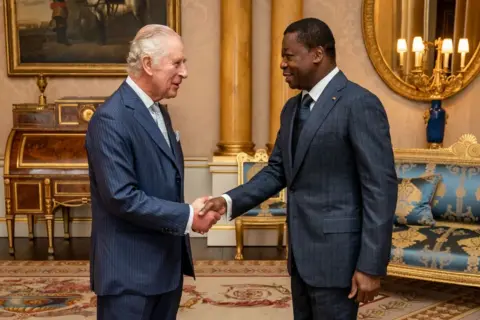
On 30 October President Emmanuel Macron welcomed Gnassingbé to the Élysée Palace for talks aimed at strengthening bilateral relations.
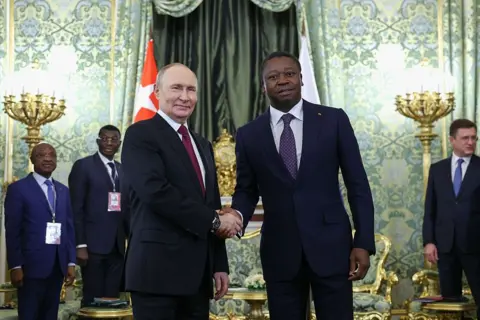
But less than three weeks later, the Togolese leader was in Moscow for a notably warm encounter with Russian President Vladimir Putin. They formally approved a defence partnership allowing Russian vessels to use Lomé port, one of the best-equipped deepwater harbours on the western coast of Africa and a key supply gateway for the landlocked Sahelian states that, following the military coups of 2020 to 2023, have become key Kremlin protégés.
While Gnassingbé’s trip to Paris was fairly low-key, his Moscow excursion was high-profile and wide-ranging.
The bilateral military accord provides for intelligence and joint military exercises (although Lomé has no plans to provide a base for the Africa Corps, the Kremlin-controlled successor to the now disbanded Wagner mercenary outfit). All this was supplemented with plans for economic cooperation and an announcement of the reopening of their respective embassies, both closed back in the 1990s.
 Anadolu via Getty Images
Inevitably all this has unsettled France, for whom Togo was once regarded as among the most devoted of allies.
When Lt Col Tigri launched his coup attempt in Benin, Macron was quick to show other Ecowas governments that it was France that could rapidly provide emergency specialist military support for their intervention to protect constitutional order.
The Togolese insist that their move to strengthen ties with Russia is not a conscious move to break ties with the West. Instead, Lomé presents the move as a natural diversification of relationships.
And there is some coherence to this argument.
Three years ago Togo and Gabon opted to complement their longstanding participation in the grouping of French-speaking countries, the International Francophonie Organisation (IOF), with membership of the Commonwealth too. Meanwhile, last year English-speaking Ghana, a Commonwealth stalwart, joined the Francophonie.
Indeed, these days many West African governments become exasperated with the outside world’s tendency to view such connections as a choice between a new Cold War alignment or taking sides in a parochial anglophone-francophone competition between former colonial powers.
They say they want to be friends with a wide range of international partners and see no reason why such relationships should be exclusive.
Togo’s premier, perhaps more than any other leader in West Africa, has sought to extend this diversified approach to his regional dealings.
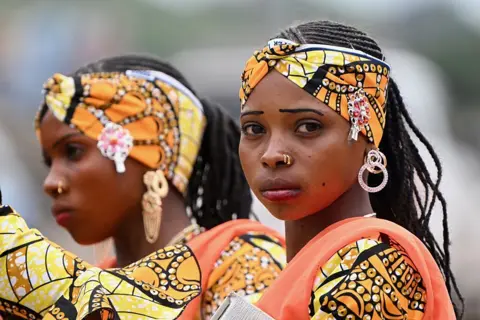
Lomé is a major freight and travel hub whose port can accommodate the largest ocean-going container ships, with feeder vessels distributing transhipped cargo to a range of other smaller or shallower ports that could not do so. From Lomé’s airport, local flights fan out across western and central Africa. The city is also home to banks and other regional financial entities.
These connections have helped to diversify the economic foundations of a country whose rural areas remain relatively poor.
 AFP via Getty Images
Togo needs to remain at the heart of the Ecowas regional grouping and, in fact, sits astride the key Lagos-Abidjan transport corridor, a major development priority for the bloc.
But Gnassingbé has concluded that he also needs to maintain strong relations with the breakaway military-run regimes, now grouped in their own Alliance of Sahelian States (AES) – which Togo’s Foreign Minister, Prof Robert Dussey has even speculated about joining.
But this is about more than economic or diplomatic diversification. It also connects to Gnassingbé’s domestic political strategy.
A constitutional change announced in 2024 and implemented this year transformed the presidency – which carries a term limit – into a purely ceremonial role and shifted all executive authority into the post of prime minister, now dubbed “president of the council” in a borrowing of Spanish and Italian terminology. This latter post is subject to no term limit.
That allowed Gnassingbé to hand over the presidency to a low-profile regime stalwart and take on the new strong premier role, with little prospect of an end limit on his rule, given the longstanding dominance of his political party, Union for the Republic (UNIR) in successive parliamentary elections.
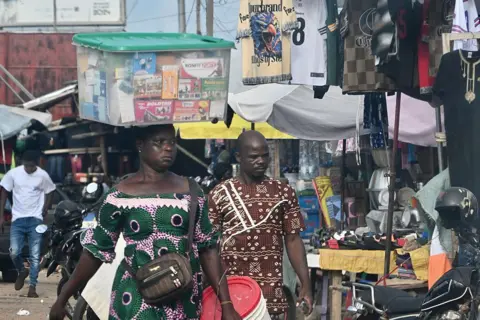
This was hugely controversial. But protest was rapidly snuffed out.
 AFP via Getty Images
Individuals even peripherally connected to demonstrations are in custody. High-profile critics such as the rapper Aamron (real name Narcisse Essiwé Tchalla) or the former defence minister Marguerite Gnakadè – who was married to Gnassingbé’s late elder brother – have been threatened with prosecution. Journalists say they have been intimidated.
Members of the government have accused protesters of violence. They have warned of “fake news” on social media, argued that human rights arguments are being used to destabilise the situation, accusing elements of civil society of fabricating allegations against the security forces.
In the words of one minister: “Effectively it’s terrorism when you encourage people to commit unprovoked violence.”
In September, the European Parliament approved a resolution demanding the unconditional release of political prisoners, including the Irish-Togolese dual national Abdoul Aziz Goma, who has been in detention since 2018.
Togo’s government responded by calling in the EU ambassador to tell him that the country’s justice system operated with total independence.
Through his diverse international strategy, Gnassingbé is seeking to warn off Western critics, signalling that he has choices and options and does not need to cede to Europe, or anyone else.
However, Togo has a history of sudden eruptions of protest or unrest.
And despite his bullish tone, the new “president of the council” may quietly have concluded that it would be wise to afford a gesture of magnanimity, to salve the resentments that still bubble under the surface.
In a state of the nation address earlier this month, he said he would instruct the justice minister to look at possible prisoner releases.
This hint of retreat from the earlier crackdown shows that even Gnassingbé’s nimble international networking cannot defuse the underlying political discontent at home.
 AFP via Getty Images
You may also be interested in:
 Getty Images/BBC