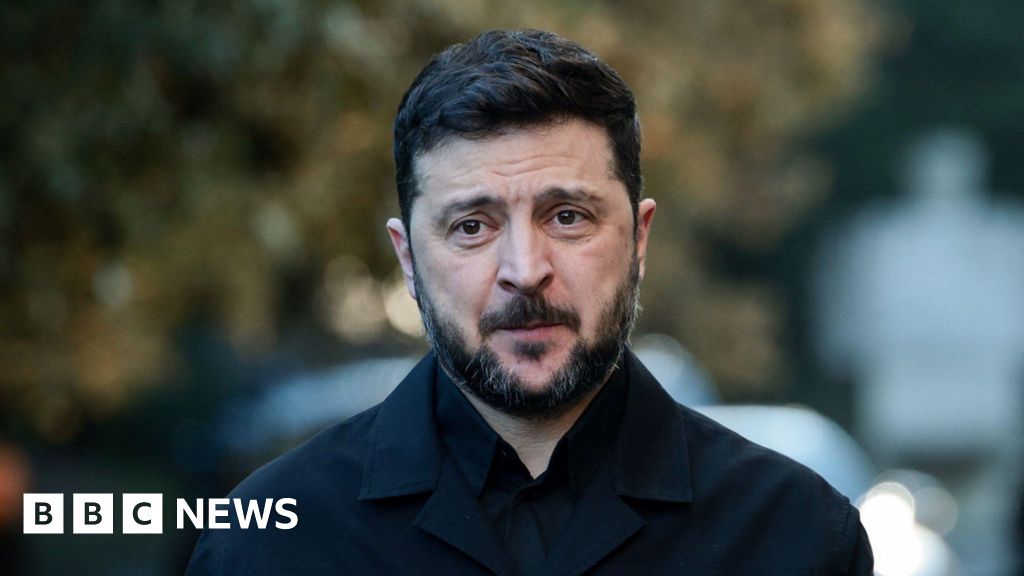
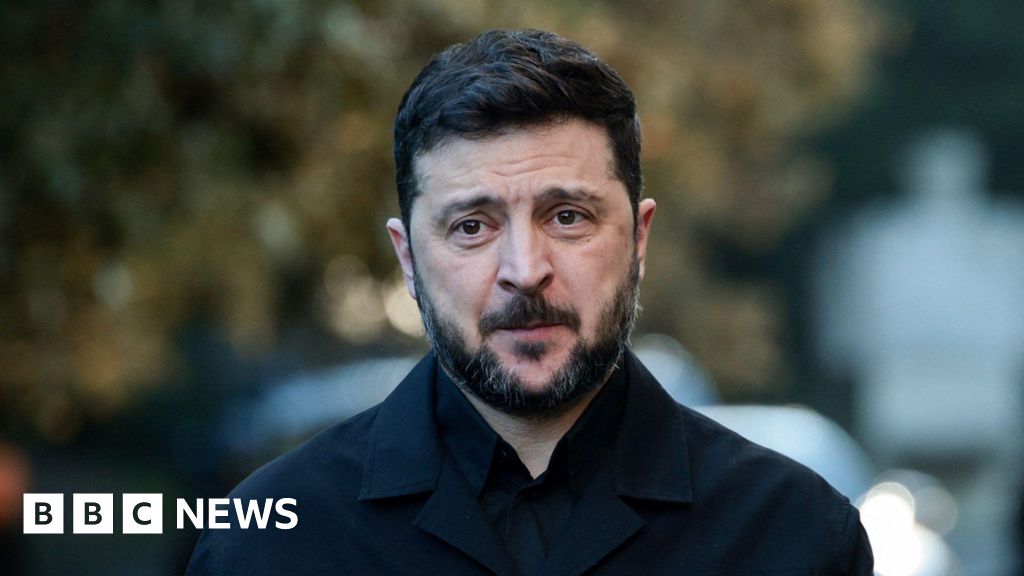
Ukraine is “ready for elections”, President Volodymyr Zelensky has said, after US President Donald Trump repeated claims Kyiv was “using war” to avoid holding them.
Zelensky’s five-year term as president was due to end in May 2024, but elections have been suspended in Ukraine since martial law was declared after Russia’s invasion.
Speaking to reporters following Trump’s comments in a wide-raging Politico interview, Zelensky said he would ask for proposals to be drawn up which could change the law.
Elections could be held in the next 60 to 90 days if security for the vote was guaranteed with the help of the US and other allies, he said.
“I’m asking now, and I’m stating this openly, for the US to help me, perhaps together with our European colleagues, to ensure security for the elections,” he told reporters.
“The issue of elections in Ukraine, I believe, depends first and foremost on our people, and this is a question for the people of Ukraine, not the people of other countries. With all due respect to our partners,” Zelensky said.
“I’ve heard hints that we’re clinging to power, or that I personally am clinging to the presidency” and “that’s why the war isn’t ending”, which he called “frankly, a completely unreasonable narrative”.
Zelensky won election in 2019 with more than 73% of the vote.
Discussions around holding elections have made headlines since Russia’s full-scale invasion of Ukraine in 2022. Russia has consistently claimed Zelensky is an illegitimate leader and demanded new elections as a condition of a ceasefire deal – a talking point which has been repeated by Trump.
“They talk about a democracy, but it gets to a point where it’s not a democracy anymore,” the US president told Politico.
There are significant practical obstacles to a wartime election.
Soldiers serving on the front lines could be either unable to vote or require leave to do so. According to the UN, there are about 5.7 million Ukrainians living abroad because of the conflict. And any ballot would require complex, additional security measures.
Such a vote would only be fair if all Ukrainians could participate, including soldiers fighting on the front line, a Ukrainian opposition MP told the BBC.
Lesia Vasylenko of Golos also told the BBC World Service’s Newsday programme that “elections are never possible in wartime”, alluding to the suspension of elections in the UK during World War Two.
Oleksiy Goncharenko, an opposition MP from the European Solidarity party, said: “I am completely against the idea, I can’t even understand why Zelensky would say it.”
“It is completely impossible,” he said, adding that elections involve an entire process of debates and campaigns. “Maybe Zelensky sees it as an opportunity to hold quasi-elections that will be favourable to him, while he controls the media and his opponents are likely not ready.”
There is little domestic political pressure on Zelensky to call elections while the conflict is ongoing, said Oleksandr Merezhko, the chairman of the foreign policy committee in Ukraine’s parliament.
There was “strong consensus” among politicians and civil organisations that elections would not be held under martial law, the MP from the Servant of the People – Zelensky’s party – told the BBC.
“Even the opposition, which is against Zelensky and would like to see him removed are against elections, because they understand the danger of attempting to hold elections during the war,” he said.
The idea was “exactly what Putin would want”, Merezhko added. “An election campaign would be divisive. Having failed to destroy us from outside, Putin wants to destroy us from within, using elections as another tool to do so.”
There is no widespread public support in Ukraine for elections, Anton Grushetsky, director of the Kyiv International Institute of Sociology, told the BBC. According to data gathered over the past week, he said, only about 10% of the population supports the idea of going to the polls before a ceasefire or peace agreement.
A poll by the Kyiv International Institute of Sociology (KIIS) in September found about 63% of people opposed holding elections after a ceasefire with security guarantees and were of the opinion that they could only be held after a complete settlement, while 22% said elections could be held after a ceasefire with security guarantees.
Yulia Tovkach, who owns a shoe business in Bucha near Kyiv, said she thought it was vital for Ukraine to end martial law before any election.
“If we don’t, we will be accused of not having a legitimate, proper election,” she said. “And to end martial law, we need a truce with security guarantees.”
Yana Kolomiets, a casting director based in the southern city of Odesa, said she thought the idea of holding an election was “foolish”, even if she was dissatisfied with Zelensky’s leadership.
“It would complicate things a lot and would not be in Ukraine’s favour,” she said.
Hanna Shelest, a foreign policy analyst with the think tank Ukrainian Prism, told the BBC that “even a year ago, Zelensky said that he was ready for elections as soon as the conditions allow” in the face of previous pressure.
The question was, however, how to create the conditions Zelensky outlined, Shelest told the Newsroom programme on the BBC World Service, given soldiers and refugees who would be voting, unsecured areas in the country and ongoing strikes.
“You cannot guarantee the security of the polling stations,” she said.
Zelensky is also facing increasing pressure from Trump to agree to a peace deal to end the war, with the US leader urging Zelensky to “play ball” by ceding territory to Moscow.
The Kremlin said Trump’s “very important” statements on Ukraine, including saying Moscow would win the war and that Kyiv would need to hand over land, align with Russia’s view.
“In many ways, on the subject of Nato membership, on the subject of territories, on the subjects of how Ukraine is losing land, it is in tune with our understanding,” Kremlin spokesman Dmitry Peskov said.