The United States says it has seized two tankers linked to Venezuelan oil exports in “back-to-back” operations in the North Atlantic and the Caribbean.
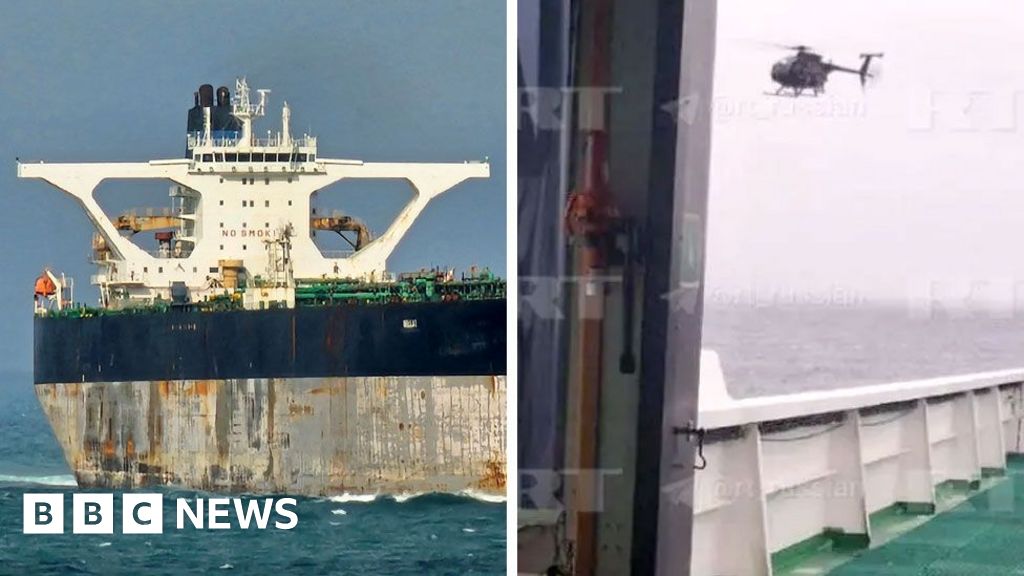
US forces boarded the Russian-flagged Marinera after a pursuit lasting almost two weeks and as it travelled through the waters between Iceland and Scotland. The British Navy gave logistical support by air and sea.
A second tanker – the M/T Sophia – was accused by the US of “conducting illicit activities” and boarded in the Caribbean.
The moves come as the US seeks to choke off most exports of Venezuelan crude oil, and just days after its special forces seized Venezuelan President Nicolás Maduro in a lighting raid on his residence in Caracas.
In a post on X, Defence Secretary Pete Hegseth wrote: “The blockade of sanctioned and illicit Venezuelan oil remains in FULL EFFECT – anywhere in the world.”
Moscow has denounced the seizure of the tanker sailing under its flag, and demanded that the US treat Russians on board properly and permits them to return to Russia quickly.
The transport ministry said it had given the vessel “temporary permission” to use the Russian flag, adding that no state had the right to use force against vessels properly registered in other states’ jurisdictions.
Reports had suggested that Russia had dispatched a submarine to safeguard the vessel, but it appears that US forces were able to board the tanker without facing any resistance.
The White House described the ship as a “Venezuelan shadow fleet vessel deemed stateless after flying a false flag and had a judicial order” against it.
Venezuela’s leadership is co-operating with the US on the second tanker seized in the Caribbean, Secretary of State Marco Rubio said.
“They understand that the only way they can move oil and generate revenue and not have economic collapse is if they co-operate and work with the United States,” Rubio told reporters.
Earlier, US President Donald Trump had said that Venezuela – which has the world’s largest oil reserves – “will be turning over” up to 50 million barrels of oil worth some $2.8bn (£2.1bn) to the US.
Rubio said that the US would sell oil that is in Venezuela “in the marketplace at market rates” and that the US would control how the proceeds were dispersed “in a way that benefits the Venezuelan people”.
He said the US had a considered plan for the future of Venezuela, and that the administration was “not just winging it”.
China – the biggest buyer of Venezuelan oil in recent years – has condemned the US moves and accused it of threatening global energy security.
The seizure of the two tankers was announced by the US military in separate posts on social media on Wednesday.
The US European Command said the M/V Bella 1 – using the former name of the Marinera – was boarded “for violations of US sanctions”.
“The vessel was seized in the North Atlantic pursuant to a warrant issued by a US federal court after being tracked by USCGC Munro”, a Coast Guard cutter.
Britain’s Ministry of Defence said RAF surveillance aircraft and a naval support vessel, the RFA Tideforce, were among the UK military assets that took part in the operation, following a US request for assistance.
Defence Secretary John Healey said the action was “in full compliance with international law”, and “formed part of global efforts to crack down on sanctions- busting”.
The vessel has been accused of breaking US sanctions and shipping Iranian oil.
Images published by Russian state broadcaster RT show a helicopter close to a ship that appears to be the M/V Bella 1.
The Russian Maritime Register of Shipping shows that the tanker had changed its name to Marinera, and was sailing under the Russian flag. Its home port stated as the southern Russian city of Sochi on the Black Sea.
The Russian transport ministry said US forces boarded the Marinera at about 15:00 Moscow time (1200 GMT), after which communications with the vessel were lost.
US officials said that Marinera was falsely flying the flag of Guyana last month, which made it stateless.
Experts told BBC Verify that the US called the ship Bella 1 as a vessel cannot change its flag during a voyage unless there was a real transfer of ownership or change of registry.
The experts also said that under UN international maritime law, a stateless vessel can be boarded by authorities.
Separately, the US Southern Command announced on Wednesday that the defence and homeland security departments “apprehended a stateless, sanctioned dark fleet motor tanker without incident”.
“The interdicted vessel, M/T Sophia, was operating in international waters and conducting illicit activities in the Caribbean Sea. The US Coast Guard is escorting M/T Sophia to the U.S. for final disposition.”
The US Southern Command also posted a video showing a helicopter circling over a vessel.
Homeland Security Secretary Kristi Noem said that “in two predawn operations today, the Coast Guard conducted back-to-back meticulously co-ordinated boarding of two ‘ghost fleet’ tanker ships”.
She said both seized vessels “were either last docked in Venezuela or en route to it”.