Jonathan HeadSouth East Asia correspondent, Mandalay, Myanmar

 Jonathan Head/ BBC
On a patch of rough ground near the Irrawaddy River, aspiring member of parliament and retired Lieutenant-General Tayza Kyaw tries to muster some enthusiasm from his audience with a speech promising them better times.
He is the candidate for the Union Solidarity and Development Party (USDP), backed by Myanmar’s military, in Aungmyaythazan, a constituency in the city of Mandalay.
The crowd of 300-400 clutch the branded hats and flags they’ve been given, but soon wilt in the afternoon heat, some dozing off.
Children run and play in between the rows of chairs. Many of these families are victims of the earthquake which badly damaged Mandalay and surrounding areas in March, and are hoping for a handout. They disappear the moment the rally finishes.
A ‘sham’ election
On Sunday the people of Myanmar get their first opportunity to vote in an election since the military seized power in a coup nearly five years ago, setting off a devastating civil war.
But the poll, already delayed many times by the ruling junta, is being widely condemned as a sham. The most popular party, the National League for Democracy, has been dissolved, and its leader, Aung San Suu Kyi, is locked up in an undisclosed prison.
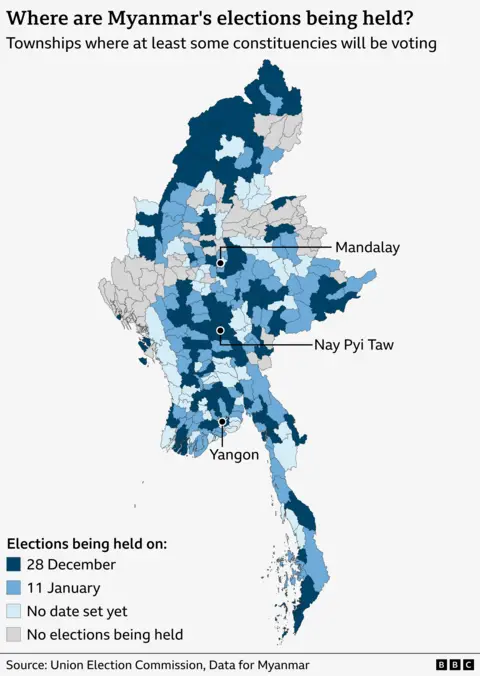
Voting, which will happen in three stages over a period of a month, will not even be possible in large parts of the country still consumed by war. Even where voting is taking place, it is marred by a climate of fear and intimidation.
When the BBC tried asking people at the rally in Mandalay what they thought of the election, we were told not to by party officials. They might say the wrong thing, one man explained – they don’t know how to speak to journalists.
The number of plain-clothes military intelligence officers present there helps explain their nervousness. In a dictatorship which has criminalised liking Facebook pages criticising the election, or using the word revolution, even these staunchly pro-military party activists feared the consequences of allowing a foreign journalist the chance to ask uncensored questions.
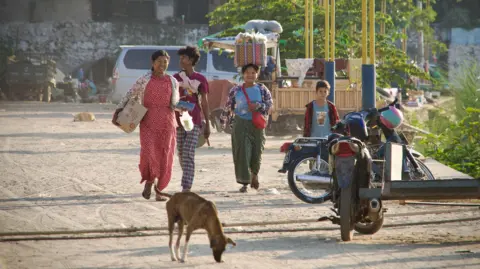
The same fear lingers on the streets of Mandalay. At a market stall selling fresh river fish the customers all refused to answer what they thought of the election. We have no choice, so we have to vote, one said. The fish seller shooed us away. “You will bring me trouble,” she said.
Only one woman was brave enough to speak frankly, but we needed to find a private place to meet, and to conceal her identity, just to hear her view of the election.
“This election is a lie,” she said. “Everyone is afraid. Everyone has lost their humanity and their freedom. So many people have died, been tortured or fled to other countries. If the military keeps running the country, how can things change?”
She would not vote, she said, but she knew that decision carried risks.
 Lulu Luo/ BBC
The military authorities imposed a new law in July criminalising “any speech, organising, inciting, protesting, or distributing leaflets in order to destroy a part of the electoral process”.
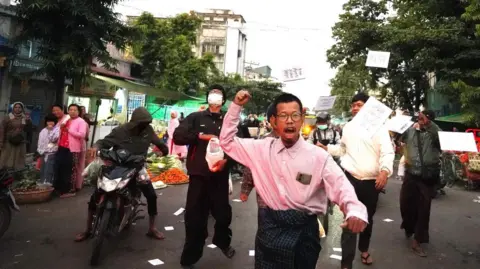
Earlier this month Tayzar San, a doctor and one of the first to organise a protest against the 2021 coup, was also among the first to be charged under the law, after he distributed leaflets calling for a boycott of the election. The junta has offered a reward for information leading to his arrest.
In September three young people in Yangon were given sentences of 42 to 49 years each for posting stickers showing a bullet and a ballot box together.
 Tayzar San/Facebook
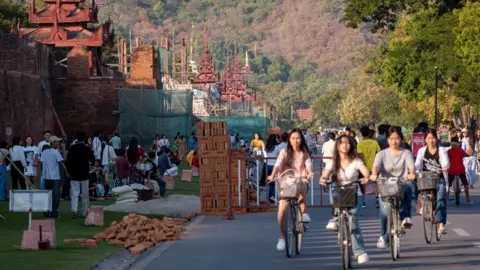
“Co-operate and crush all those harming the union,” commands a large red poster looming over the families and couples enjoying a late afternoon stroll under the old red-brick walls of the royal palace in Mandalay.
In this menacing climate anything approaching a free vote is unimaginable.
A general’s gambit
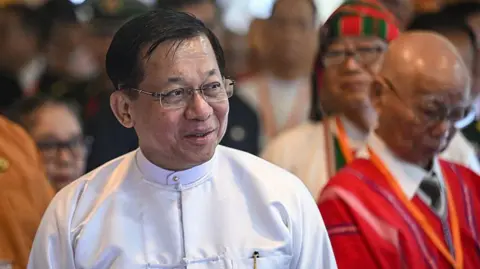
Yet the junta leader Min Aung Hlaing has a spring in his step these days. He seems confident this extraordinary election, where there will be no voting at all in as much as one half of the country, will give him the legitimacy he has failed to acquire during his five catastrophic years in power.
He even attended a Christmas mass in Yangon’s cathedral and condemned the “hatred and resentment between individuals” which led to “domination, oppression, and violence in human communities”.
This, from a man charged by the UN and human rights groups with genocide against Muslim Rohingyas, whose coup set off a civil war which, according to the data analysis group ACLED, has killed 90,000 people.
 AFP via Getty Images
Min Aung Hlaing’s election gambit has the full diplomatic support of China, which, bizarrely for a one-party state, is giving technical and financial support for this multi-party exercise. It is likely to be reluctantly accepted in the rest of Asia too.
His army, newly equipped with Chinese and Russian weapons, has been regaining ground lost over the past two years to the various armed groups opposing the coup. He is clearly hoping to include more reconquered territory in the third stage of the election at the end of January.
With Aung San Suu Kyi and her NLD out of the picture his USDP is all but guaranteed to win. In the last, free election in 2020, the USDP won only six percent of parliamentary seats.
Some observers have noted that Min Aung Hlaing is not popular even within his own regime, or his own party, where his leadership qualities are questioned. He will probably keep the presidency after the election, but his power will, to some extent, be diluted by the resumption of parliamentary politics, albeit without most of the parties that won seats in the 2020 election.
The election is clearly viewed by China as an off-ramp, a way for the military to get out of the destructive deadlock caused by its ill-judged coup.
‘No-one is ready to compromise’
Even a short distance from the apparently peaceful city life of Mandalay, the deep scars left by Myanmar’s civil war, which is still far from over, are visible.
On the opposite side of the Irrawaddy River lies the spectacular temple complex at Mingun, once a popular tourist attraction. Getting there requires a short drive along a riverside road, but for the past four years this, like much of the area around Mandalay, has been contested territory, where volunteer People’s Defence Forces control many villages and launch ambushes against army convoys.
To reach Mingun we needed to get through several checkpoints. We sat in a tea shop with the local police commander to negotiate our passage.
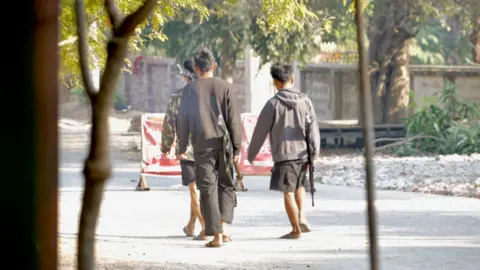
He was a young man, wearing the huge strain of his job on his face. He had a revolver stuck in the back of his trousers, and two even younger men – boys, perhaps – carrying military-issue assault rifles sat close by as his bodyguards.
 Lulu Luo/ BBC
He said he had to carry these weapons just to move about the village.
On his phone were images of his opponents: young men, raggedly dressed, with an assortment of weapons they may have smuggled from border regions of Myanmar or obtained from dead soldiers and police officers. One group, calling itself the Unicorn Guerrilla Force, was his toughest adversary. They never negotiated, he said. “If we see each other we always shoot. That’s the way it is.”
The election, he added, would not be taking place in most of the villages to the north of him. “Everyone here has taken sides in this conflict. It is so complicated and difficult. But no-one is ready to compromise.”
After an hour we were told it would be too dangerous to reach Mingun. The PDFs might not know you are journalists, he said.
 Jonathan Head/ BBC
There is little sign of compromise either from the military men who overturned Myanmar’s young democracy, and who now want to revamp their regime with a veneer of quasi-democratic respectability.
Asked about the appalling civilian casualties since the coup, and the air strikes against schools and hospitals, General Tayza Kyaw blamed them entirely on those who opposed the military takeover.
“They chose armed resistance,” he said. “Those who are with the enemy cannot be viewed as the people, according to the law. So, they are just terrorists.”
People in Mandalay say this election has none of the colour and energy of the 2020 election. There have been few rallies. Only five other parties are being allowed to challenge the USDP nationwide, and none has its resources and institutional backing. Turnout is not expected to be high.
And yet such is the fear of possible retribution, or just exhaustion from the civil war, many Burmese people will still go to the polling stations, whatever their views of the election.
“We will vote” one woman said, “but not with our hearts.”
Additional reporting by Lulu Luo