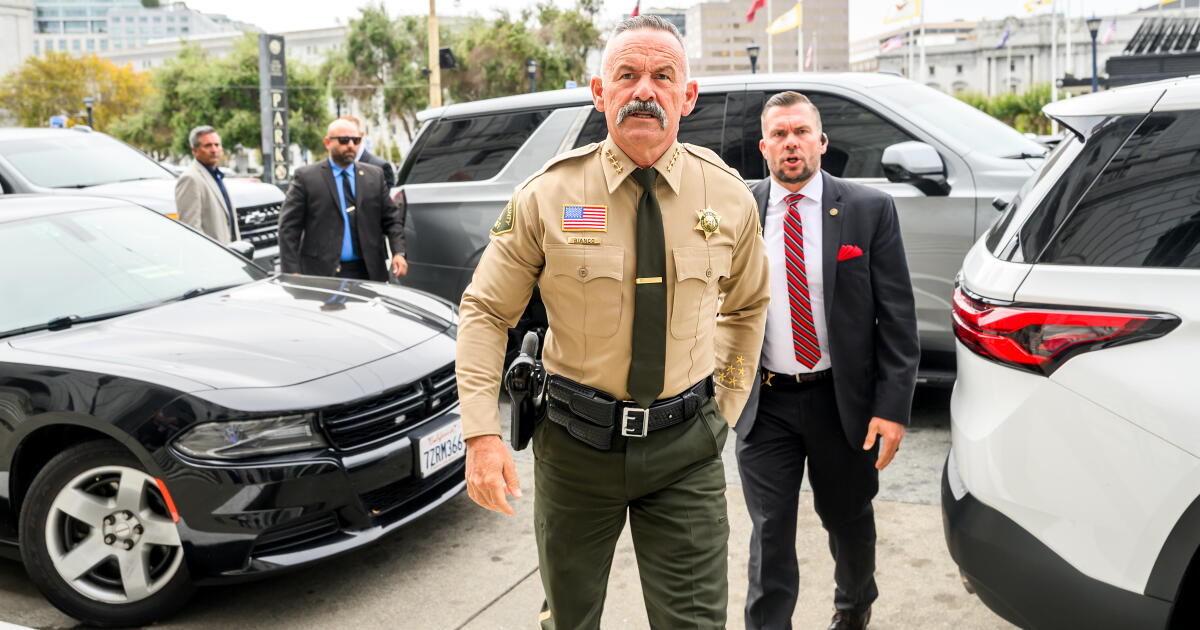
The California Supreme Court excoriated Riverside County Sheriff Chad Bianco over his seizure of hundreds of thousands of Proposition 50 ballots earlier this year, ordering the former gubernatorial candidate to immediately hand over all remaining materials in a pair of scathing decisions Thursday.
“We hold that the seizure of the ballots was unlawful,” wrote Chief Justice Patricia Guerrero. “While allegations of election improprieties are a very serious matter, our Elections Code contains numerous established mechanisms for investigating and proving misconduct that do not compromise the integrity of voted ballots — contrary to the means employed here.”
California voters overwhelmingly passed Proposition 50 in a special election last fall, blessing a new congressional map that all but eliminated Republican districts in response to gerrymandering efforts in Texas and other deep-red strongholds.
Bianco, a popular MAGA personality and former Republican candidate for governor, doggedly pursued claims the Riverside County returns were fraudulent, seizing on a discrepancy between the registrar’s voluntary hand tally and the official vote count to commandeer the ballots as evidence of a crime — a move the court roundly rejected.
“A criminal prosecution commences only upon the occurrence of certain events — none of which has occurred in this case — and may only be initiated by a public prosecutor,” Guerrero wrote. “But even if a criminal prosecution had commenced, allowing for a court-ordered production, [the law’s] plain text prohibits the removal of the ballots from the registrar’s physical custody.”
The ruling comes less than two weeks before Californians will start casting ballots in the race for governor and a handful of bitter congressional contests — nationally-watched elections that would be vulnerable to similar interference unless the court gave clear orders, advocates warned at oral arguments last month.
“It’s bound to be repeated again,” said Chad W. Dunn of the UCLA Voting Rights Project, which led the first of two related suits against Bianco.
California Atty. Gen. Rob Bonta, who brought the other suit, cheered Thursday’s rulings as an important electoral safeguard.
“The Court has now made clear that this kind of defiance cannot stand,” Bonta said in a statement following the twin decisions. “I encourage Californians to make their voices heard and vote early in the fast-approaching November 3 midterm elections, with the confidence of knowing that their voted ballots will never again be subject to physical seizure by rogue county sheriffs.”
Bianco did not immediately respond to a request for comment.
Bianco has long flirted with President Trump’s election fraud conspiracy movement. Though the ballot seizures in February were widely seen as a campaign stunt, the legal theory behind them — that local lawmen can commandeer voter materials from elections officials, and that sheriffs are unanswerable to officials who outrank them, including attorneys general — belongs to a larger “constitutional sheriffs” ideology.
California‘s seven Supreme Court justices appeared by turns perplexed by and incredulous of those theories during oral arguments last month.
“You are walking into a very dense thicket of very specific laws that govern elections in particular and I think it’s a very established cannon of interpretation that the specific trumps the general,” said Associate Justice Goodwin H. Liu.
Thursday’s rulings effectively short-circuited Bianco’s efforts to keep the ballot probe alive.
“Bianco presumably could have used traditional investigatory tools, within the bounds of the law, to obtain other evidence of election-related crime,” Guerrero wrote.
Further, the court said, Bonta’s authority to stop both the seizure and the ad hoc recount was unequivocal.
“Respondents’ arguments all boil down to the unsustainable view that the state’s chief law enforcement officer … must remain a mere bystander to an unprecedented sheriff’s investigation of undeniable statewide significance,” Guerrero wrote. “As we have explained, that is not the case.”
In a footnote, justices also took a swipe at Bianco’s initial effort to have the case tossed for lack of standing — a move apparently undertaken on the legal advice of an elaborate AI hallucination, reminding lawyers of their “professional duties of competence and candor.”
The ballot battle emerged from a Riverside County pilot program meant to boost voter confidence — a handwritten tally that ultimately fell about 46,000 votes short of the official count, sparking claims of fraud.
The registrar of voters met with the county board of supervisors and the citizens’ group behind the claim and carefully explained how the discrepancy emerged. Yet, Bianco pursued warrants to seize more than 650,000 ballots, alleging they were evidence in an investigation of wide-ranging misconduct.
When he learned of the warrants, Bonta ordered Bianco to stand down. Instead, the sheriff accelerated his plans, dispatching armed deputies from Riverside County’s Special Investigations Bureau, Emergency Response Team and SWAT unit to sweep up the votes.
Later, Bianco directed his underlings to begin counting those ballots by hand — a potential felony under state law, which forbids anyone other than election officials from so much as touching a ballot container.
When Bonta again ordered him to stop, Bianco argued the attorney general had no authority to command him, later claiming in court that the law conferred only an “advise and consent” role.
Spurred by the Riverside dustup, lawmakers in Sacramento recently passed a “raft of additional legislation” to shore up ballots and empower elected officials to protect them in the future.
“It is a lot to ask of our election officials that they not only do their jobs competently but also stand ready to sue anyone who unlawfully interferes with their duties. Yet here we are,” Liu wrote. “For our democracy to flourish, our elections must be conducted in accordance with the law.”