Author
Ahmed Barakat
Author

Share


Bitcoin News: BTC price climbed from $61,100 to above $63,400 on June 11 after President Trump cancelled planned Iran strikes and said a peace deal memo of understanding could be signed as early as this weekend, a 3% move that matched a broad risk-on rally across equities.
The catalyst cleared one major headwind, but it arrived against the backdrop of 13 consecutive sessions of Bitcoin ETF outflows totalling $4.4 billion, the worst institutional redemption streak since spot products launched in January 2024.
The Federal Reserve meets June 16–17, and that overhang has not moved.
Discover: The Best Crypto to Diversify Your Portfolio
Bitcoin News: Iran Deal Sparks Risk-On Rally Across Crypto and Equities
Trump’s announcement that the US had stepped back from planned Iran strikes, and that Iran had agreed to much of the draft text of a peace framework, removed a risk premium that had been sitting on markets for weeks.
The S&P 500 jumped 1.75%, the Nasdaq surged 2.5%, and the Dow gained over 900 points on the same session. BTC price tracked all three, not gold.
That is the key distinction. Bitcoin’s behaviour through the Iran episode cuts directly against the safe-haven narrative.
When US-Iran tensions escalated, BTC fell alongside equities. When Trump announced the deal, it surged 3% in lockstep with the Nasdaq, a textbook risk-on move, not a safe-haven hold. Brent crude confirmed the macro read, dropping around 3% to near $90 a barrel as Strait of Hormuz supply risk eased.
Altcoins outran Bitcoin on the news. ETH gained 4%, Solana surged 6.8%, and Cardano climbed 6.6%, the kind of leverage differential that shows up when institutional risk appetite snaps back quickly across the liquidity stack.
Some analysts argue the selloff that preceded this move looks more cyclical than structural, pointing to the speed of the price recovery as evidence the underlying bid remained intact throughout.
$4.4 Billion Out in 13 Sessions, The ETF Streak That Defines Institutional Positioning
Thirteen consecutive sessions. $4.4 billion in net outflows from spot Bitcoin ETF products. That is the worst redemption streak since spot ETFs launched, and it frames everything about the current setup.
Fidelity’s FBTC absorbed some of the heaviest selling pressure across the stretch, with IBIT also recording significant single-session redemptions, $214 million in one session on June 5 alone.
The outflow streak reflects demand drying up at the institutional level, driven by two simultaneous headwinds: geopolitical risk pushing capital toward gold and bonds, and Fed uncertainty suppressing risk appetite ahead of FOMC.
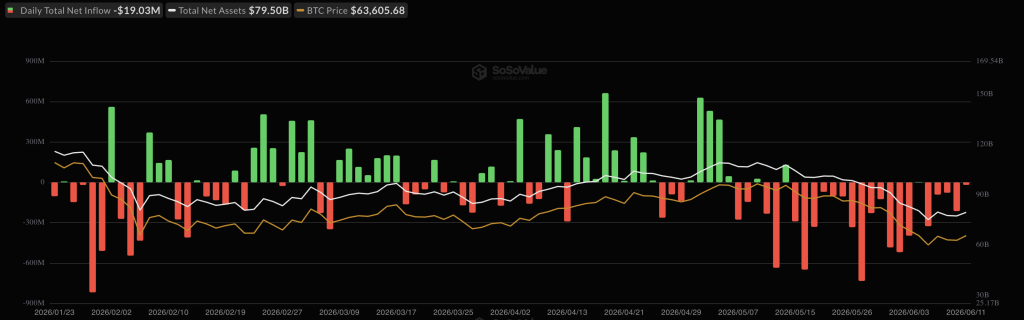
One of those drivers cleared on June 11. The other has not. Bitcoin held its price through the bulk of the redemption streak, which is either a signal of resilience from retail and offshore demand absorbing institutional exits, or a tension that still needs resolution. We are not resolving it here.
Flow analysts have consistently flagged the divergence: strong price reactions to Iran headlines, ongoing US ETF outflows. The collapse in institutional and corporate BTC buying is the structural context the Iran rally sits inside. One relief catalyst does not erase 13 sessions of redemption behaviour on its own.
Discover: The Best Token Presales
FOMC June 16–17: The Headwind That Didn’t Clear
One headwind cleared. One remains. The Federal Reserve meets June 16–17, with market odds of a rate hold sitting at 98%.
A hold is fully priced in, that is not the risk. The risk is in the statement and forward guidance that follows the decision.
Institutional caution through the full 13-session outflow streak was not purely about Iran. Stronger-than-expected May payrolls, rising Treasury yields, and fading near-term rate-cut expectations all compressed the case for re-risking into Bitcoin.
If the Fed signals a clear path toward cuts at the June 17 FOMC statement, the remaining macro headwind lifts and institutional flows have a cleaner re-entry argument.
If the statement reads hawkish or ambiguous, higher for longer extended further, the relief from the Iran deal could fade fast.