
Author
Ahmed Barakat
Author

Share

In the latest Chainlink news, Kraken has officially replaced LayerZero with Chainlink CCIP as the exclusive cross-chain infrastructure layer for its wrapped asset suite, including kBTC, with coverage spanning Ethereum, Ink, Unichain, and Optimism, and additional networks expected in later phases.
The exchange cited defense-in-depth security architecture, independent node operators, built-in rate limits, and formal certifications-ISO 27001 and SOC 2 Type 2-as the operational basis for the switch. The migration follows a $292 million LayerZero exploit that accelerated industry reassessment of first-generation bridge infrastructure.
Bullish signal for LINK holders.
This is not an isolated preference. Kelp, Solv, and Re-protocols collectively representing more than $2.5 billion in total value locked-have announced parallel transitions toward Chainlink CCIP infrastructure. Coinbase made CCIP the exclusive bridge for approximately $7 billion in wrapped assets including cbETH in 2025, citing the same security consolidation rationale.
Kraken’s move extends that pattern into crypto-native exchange infrastructure, where wrapped asset failures carry direct reputational and custodial risk for a regulated venue.
Discover: The best crypto to diversify your portfolio with
Chainlink News: How Kraken’s CCIP Migration Actually Works-and Why the Security Argument Is the Real Story
The mechanism here is worth understanding in detail, because the LayerZero-to-CCIP switch is not just a vendor swap; it reflects a fundamentally different trust architecture.
LayerZero routes cross-chain messages through configurable relayers and/or oracles chosen by the application developer, which maximizes flexibility but concentrates trust assumptions in operator selections that vary by deployment.
CCIP operates through Chainlink’s decentralized oracle network, backed by a separate Risk Management Network-an independent cluster of nodes that monitors for anomalous activity in real time and can halt transfers before losses propagate.
Wrapped assets like kBTC work by locking Bitcoin collateral and minting a synthetic token that moves across smart-contract-enabled chains, allowing Bitcoin liquidity to circulate through DeFi lending, trading, and yield applications.
The security of that collateral-to-synthetic link is foundational-a bridge failure does not just freeze transfers, it can drain the locked collateral entirely, as the April 2026 Kelp incident demonstrated when 116,500 rsETH was drained from a LayerZero-powered bridge. CCIP’s rate-limit architecture and audit trail are specifically designed to contain that failure mode.
Chainlink oracles already secure roughly 70% of the DeFi oracle market and more than 80% on Ethereum, with CCIP integrated into blue-chip protocols including Aave and Lido.
That existing footprint materially reduces integration friction for exchanges like Kraken and gives CCIP a network effect advantage that pure messaging competitors cannot replicate quickly.
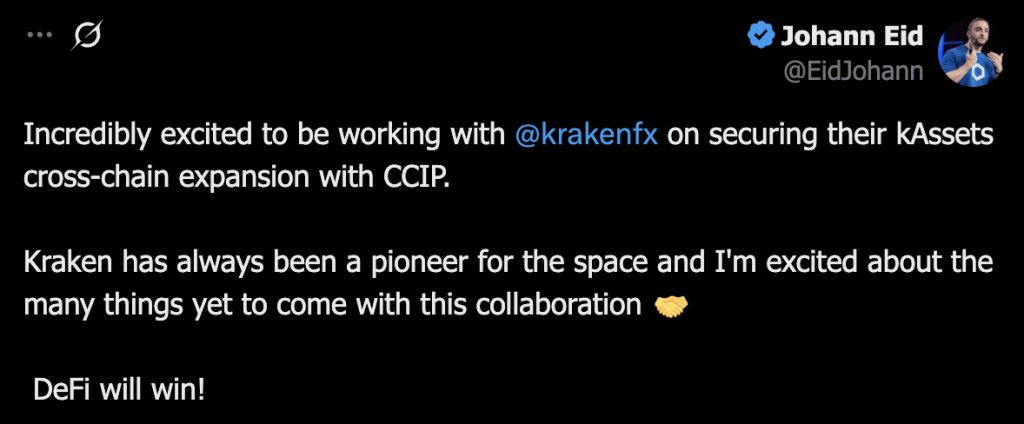
Johann Eid, Chief Business Officer at Chainlink Labs, framed the institutional logic directly: “Kraken’s migration reflects growing institutional demand for cross-chain systems capable of meeting enterprise-level security requirements.”
Discover: The best pre-launch token sales