One more day and it’ll all be over. I’m referring to the primary election, of course, and the unremitting campaign ads that have infiltrated every aspect of our being as Californians.
Authentic or paid influencers promoting candidates on TikTok and Instagram. Facebook ads vilifying or praising various measures. Incessant, repetitive TV campaigns that get nastier with every election, yet still manage to feel like an analogue remnant from 1982. The worst? Those sponsored leaflets and postcard mailers that end up as makeshift coasters, mosquito swatters or unread refuse that goes straight from the mailbox into the blue recycle bin.
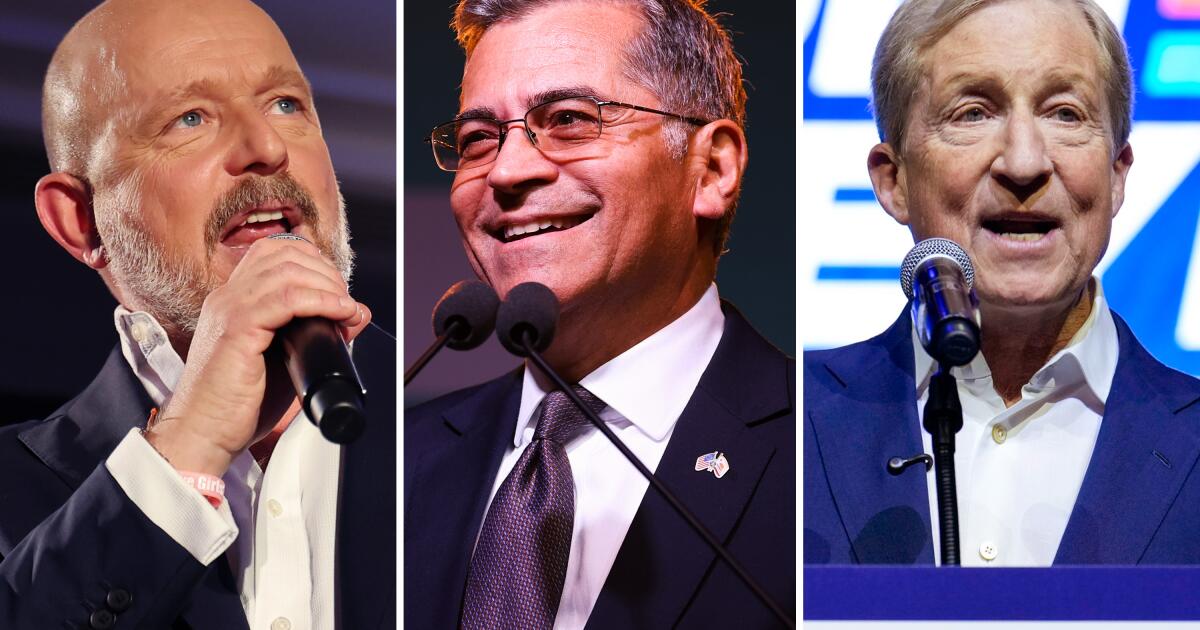
The king of ad spending is Democratic gubernatorial candidate Tom Steyer. He’s behind the most expensive political advertising campaign in the country this year. A former hedge fund manager, Steyer has reportedly spent more than $200 million on his campaign, with a major chunk of that for broadcast TV, cable and radio — 20 times the amount spent by fellow Democrat, former U.S. Secretary of Health and Human Services and California Atty. Gen. Xavier Becerra. And Steyer is still polling behind Becerra.
I never thought I’d write this but it’s not always about the money.

Xavier Becerra, front-runner in the race for California governor, speaks before a crowd at UFCW Local 1167 Union Hall.
(Genaro Molina/Los Angeles Times)
Voters have more resources than ever should they choose to actually research and learn about who and what is poised to shape the future of their city, county and state.
There’s no shortage of broadcast, cable, digital and print reporting about former reality TV personality turned mayoral candidate Spencer Pratt. He uses AI!
The battle between incumbent Karen Bass and her closest Democratic competition, Los Angeles city council member Nithya Raman, dominates local newscasts. And there’s pundits from both sides arguing for and against these choices on every available platform.
Given the amount of information now at voter’s fingertips, we should be the most informed voting populace in the history of ballot casting. But are we?
A new poll by UC Berkeley’s Institute of Governmental Studies that was co-sponsored by the Los Angeles Times asked 8,578 registered voters across California what sources they rely on to get news and information about election-related issues. The poll, which was conducted online May 19-24 in English and Spanish, found that nearly half of the state’s electorate (47%) said they refer to the official voter information guide that is mailed to voters in advance of each election.
Discovering that a nonpartisan, non-sponsored source of data topped the list is a welcome surprise. Today’s media-verse is so fractured and bifurcated along political lines, I just assumed that confirmation bias would drive most folks toward friendly sources, i.e. what they want to hear.
Not as surprising is that 44% of those polled said they use Google or other search engines to seek out election-related information, and greater than 3 in 10 obtain election-related information from social media (39%). Traditional means of information weren’t far behind search engines. Those polled said they still rely on national or cable TV news (39%), newspapers, online or in print (37%), and local TV news (35%). One in three (33%) get information word-of-mouth from family, friends, neighbors or co-workers.

Gubernatorial candidate and billionaire Tom Steyer, right, meets with supporters at a campaign stop.
(Sara Nevis/For The Times)
“The substantial differences in news sources across generation, education and partisanship suggest that we are a considerable distance from the information environment that dominated most of the 20th century, where local newspapers, network news and local television stations dominated,” said Professor Eric Schickler, co-director of the Institute of Governmental Studies. “This fragmentation means that voters may no longer share a common frame of reference when evaluating candidates and election issues.”

The increasingly splintered ways in which voters seek information, fueled by the rapid changes in technology and media, has kept political campaign strategists on their toes.


“Getting attention is the first barrier, and then once you have that attention, how do you convert that into support?” says Democratic campaign consultant and strategist Brian Brokaw. “You have to create a surround-sound effect in order to persuade the voter to go for your candidate or your issue, and they have to hear from multiple avenues. Voters are innately skeptical of advertising, especially when it’s a very direct sale from a candidate. That’s why you’re seeing the use of more influencers in campaigns, particularly paid influencers, who may or may not be disclosing that they are being paid. That’s been a prominent issue in the governor’s race.”
Age, or generational differences, are another deciding factor in where voters look for more intelligence on issues and candidates. The poll found that two-thirds of voters under the age of 30 (67%) and a majority of those ages 30-39 (52%) use social media such as Facebook, X, Instagram, or TikTok to get their information.
Getting to know a candidate, particularly via social media, isn’t necessarily part of a rigorous, fact finding mission. Laughing at Pratt’s Batman-themed video or Gov. Gavin Newsom’s satirical X posts are more about bonding with the person than unpacking their policies. Real or perceived, discovering a candidate via one’s Instagram feels more organic than seeing them on billboard or TV ad.
“One way that politics has changed is that people are craving authenticity. Someone like [Zohran] Mamdani, was very successful and promoted himself from the back of the pack to mayor of New York City. But what people are seeing doesn’t mean that’s the truth,” warns Republican consultant and campaign strategist Kevin Spillane. “I’ve been involved in politics for 40 years. A lot of people are not how they present themselves. But we still crave authenticity, we want to believe [in someone], we want that connection.”
We’ll soon see who Californians choose to represent them and their concerns — or which candidate waged the best campaign warfare, substantive political arguments be damned. But it may take a minute to count all the votes. California reached a record number of registered voters ahead of Tuesday’s primary election, according to the Secretary of State’s office. Officials say more than 23.1 million Californians are now registered to vote statewide.
West Coasters who want to understand what they’re voting for have infinite resources to turn to, some more useful than others. Sponsored mailers (the aforementioned mosquito swatters) only appealed to 9% of those polled as a useful source of information. But did you really need a poll to tell you that?