Author
Ahmed Barakat
Author

Share

Fact Checked by
CryptoNews Editorial Team
Author
Hyperliquid (HYPE) is outpacing Solana (SOL) on price, and the gap is widening. SOL has dropped to its lowest level since 2023, caught in a broader DeFi rotation out of general-purpose L1S, while HYPE has absorbed that displaced capital and kept climbing.
But price momentum and market cap dominance are different animals. Solana’s circulating market cap still sits above $38 billion, backed by institutional infrastructure, CME futures, spot ETF flows, and Tier-1 collateral status across every major prime brokerage, which Hyperliquid has not built and cannot replicate quickly.
The flippening narrative is real as a trading thesis. As a structural outcome in the near term, it doesn’t hold up.
Discover: The Best Crypto to Diversify Your Portfolio
Solana vs. Hyperliquid Liquidity Moat Is Not a Talking Point, It’s a Balance Sheet Reality
The institutional crypto infrastructure gap between these 2 assets is not marginal. Solana is embedded as core collateral across centralized exchanges, institutional prime desks, and an expanding ETF ecosystem.
That collateral utility translates into structural buy pressure that exists independent of narrative cycles.
Hyperliquid is a specialized perpetual DEX, a highly optimized application-specific chain built for trading. It does that job exceptionally well.
But a specialized instrument and a platform asset are valued on entirely different frameworks, and historically, general-purpose settlement layers command a significantly higher monetary premium than single-purpose trading venues.
The FDV trap is also real. Most flippening comparisons lean on Hyperliquid’s fully diluted valuation rather than the circulating market cap.
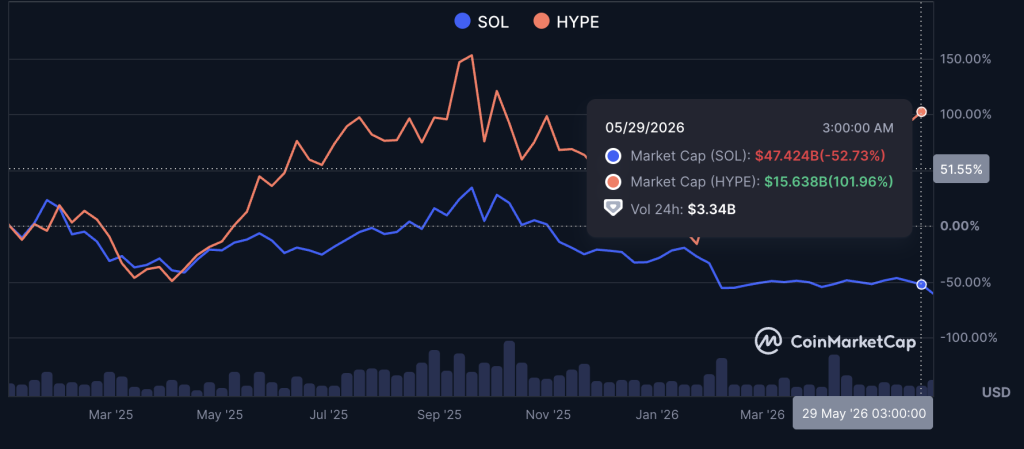
For HYPE to overtake SOL on a circulating basis, it would need to sustain current price levels while its float expands materially over the next 2 to 4 years, a dilution challenge Solana has already largely navigated through its own post-2022 rebuild.
Consider the liquidation asymmetry. The $1.1 billion market-wide liquidation event that accelerated SOL’s drop to 2023 lows also stress-tested Hyperliquid’s risk infrastructure.
HL’s protocol survived, but the episode underscored that its resilience is still being established in real time, while Solana’s depth absorbs that kind of volatility without structural impairment. Understanding how capital rotation dynamics actually move between asset classes matters here; money flowing into HYPE is not the same as money building institutional infrastructure around it.
Solana’s network effects run deeper than trading. Visa integrations, DePIN protocols, thousands of active applications, these create diversified fee revenue and ecosystem stickiness that a perps-focused AppChain simply cannot replicate. S
OL’s revenue doesn’t collapse if derivatives volume drops 40%. HYPE’s revenue thesis depends almost entirely on sustained leverage demand.
The Hype Bull Case Is Serious, Don’t Dismiss It
Arthur Hayes has publicly argued HYPE can outperform SOL before this bull cycle ends, leaning on Hyperliquid’s fee revenue trajectory and the durability of speculative demand.
However, at the time of writing, he published a post saying he dumped his entire stack.
Syncracy Capital’s Daniel Cheung framed Hyperliquid as “the main chain where trading activity is happening” and the venue “bringing new users into crypto right now”, citing its 24/7 markets as a structural advantage over venues constrained by traditional market hours.
The mindshare argument is genuine. When a protocol becomes the default destination for active traders, that creates compounding volume effects that are hard to dislodge.
Discover: The Best Token Presales