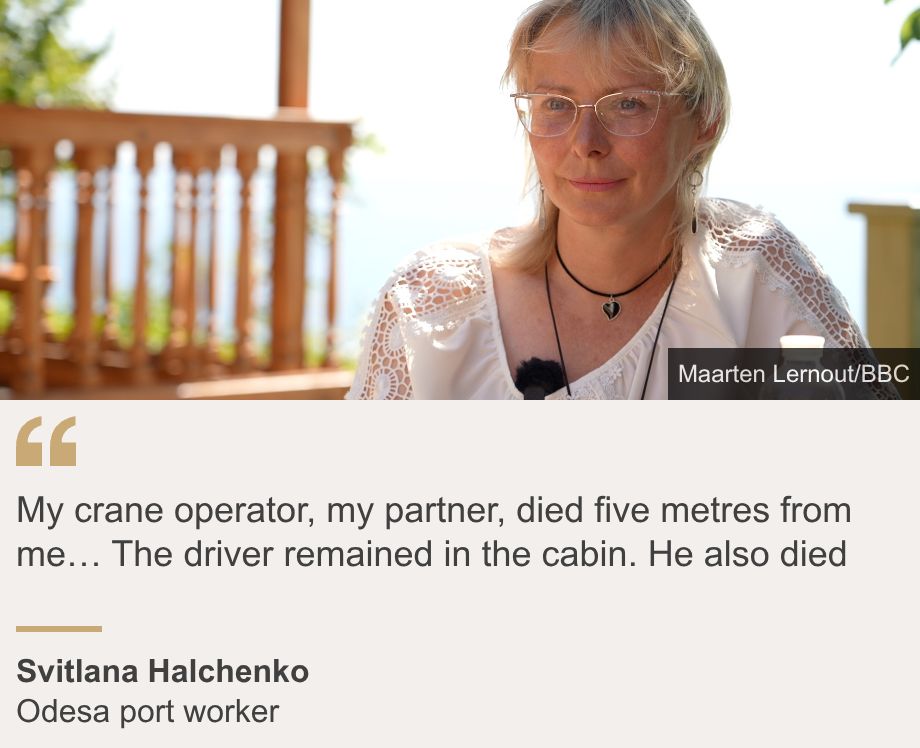
“My crane operator, my partner, died five metres from me… The driver remained in the cabin. He also died.”
Svitlana Halchenko winces as she remembers the Russian ballistic missile which exploded at work in Odesa, killing her colleagues.
Svitlana works as a warehouse shift manager at the city’s main port.
Despite her injuries – she walks with a limp, pieces of shrapnel still embedded in her leg and back – Svitlana is determined to keep working.
But her normally bustling workplace is largely silent.
Russia is ramping up its efforts to strangle Ukraine’s commercial links to the outside world, launching attacks all along the country’s Black Sea coastline.
From damaged port infrastructure to listing ships with bridges blackened and containers still smouldering, the evidence is everywhere. Nowhere more so than out towards the horizon, where the approaches to Ukraine’s once bustling ports – Odesa, Chornomorsk, Pivdennyi – are almost devoid of ships.
Svitlana maintains a brave smile throughout our conversation, but her distress is painfully obvious. Her fingers constantly twist a tissue as she tries to maintain her composure and she gazes into the distance as tears well up behind her glasses.
The last few weeks have been worse than ever.
“It’s been very difficult for morale,” she says with a deep sigh. “A lot of sirens, a lot of shaheds [drones], a lot of hits. People are very tense.”

My crane operator, my partner, died five metres from me… The driver remained in the cabin. He also died
According to Ukraine’s port administration, July saw 57 Russian attacks on civilian vessels, 22 of them at sea, and a further 67 hits on port infrastructure.
While there have been Russian attacks on international vessels before, they’ve never been so numerous or so deadly.
On July 19, a Turkish-owned cargo vessel, Golden Leo, was struck by three Russian missiles, killing nine Indian and Syrian crew members and a Ukrainian pilot.
The ship, carrying Ukrainian corn, sank off Odesa a week later.
According to the global shipping journal Lloyd’s List, the Black Sea may now be the most dangerous place for shipping in the world – with July the deadliest month for merchant seamen since Russia’s full-scale invasion of Ukraine began.
At his union’s offices in the port city, Oleg Grygoriuk, Chairman of the Marine Transport Workers Union of Ukraine, says his members are suffering.
“There are a lot of veterans who already served their country,” he says, “and they literally say that being in the port is more scary than being on the front line.”
Odesa’s proximity to Russian-occupied territory means that workers often have little time to react.
“A missile flies from Crimea within a minute,” he says. “If you are sitting in a crane, you need three and a half minutes to get down and go to the shelter. There’s literally no time to do that.”
On a rare visit to one of the area’s main ports, we saw almost no sign of movement. Hundreds of metres of berths sat empty and towering gantry cranes stood idle as a skeleton crew conducted maintenance.

The military authorities allowed the visit on strict condition that we neither name the facility nor film anything. Ukraine doesn’t want Russia to know what has and hasn’t been damaged or reveal details that might aid Moscow in further targeting.
Two damaged cargo vessels were moored nearby. Both had suffered severe damage to the superstructure, where the bridge and crew quarters are located.
Just one lone freighter was seen moving towards the port.
“My heart is broken,” a senior manager told us on condition we didn’t name him.
“Normally there’s a queue, even out at sea, waiting for a berth.”
“There was a deal,” he said, referring to the UN-brokered 2022 Black Sea Grain Initiative, under which Russia agreed to lift its blockade on Ukraine’s agricultural exports. The agreement established safe maritime corridors to Odesa’s main ports.
“They stopped the deal in the middle of 2023, but they didn’t start attacking it until recently,” the manager said.
“Today they do it systematically.”
Halfway through our tour, sirens sounded, forcing us to seek shelter for several minutes as a Russian jet-powered drone flew overhead.
Weary dock workers scanned their phones for updates until the all-clear sounded.
The manager said recent alerts have forced the port to shut down for 15 out of 24 hours.
Technically, the port is open, as are all the others in the area. There is no prohibition on commercial ships attempting to use them. But the risks are clearly too great for most shipowners.
“There is barely anybody who wants to call because there is a huge problem with people getting killed,” says Andrey Stavnitser, co-owner and CEO of one of the largest ports in the area.
“We can see that the whole supply chain is on hold.”

Stavnitser says Russia is almost certainly retaliating for Ukraine’s recent, highly successful attacks on Russian shipping, including sanctioned vessels carrying oil, as well as other ships involved in ferrying supplies to Russian-occupied Crimea.
Using its own drones, Ukraine’s Operation MoLoChKa (which roughly translates as “Moscow will fall through Crimea”) has struck around 200 Russian vessels, bringing traffic in the strategic Sea of Azov to a virtual standstill.
Ukrainians bristle at the suggestion that Russia and Ukraine are playing the same game. Kyiv is attempting to loosen Moscow’s grip on occupied territory, they point out, while Russia is preventing Ukraine from exporting badly needed grain to the international market.
With Ukraine’s summer grain harvest well under way, this is all happening at the worst possible time.
“It’s the most sensitive period,” says Volodymyr Slavinskyi, trading director for Nibulon, one of the country’s leading grain exporters.
“Farmers need to quickly harvest grains from the fields, not to lose the crop. They need to be able to sell the crop they harvested and reinvest money in the next production cycle.”
The impact of a prolonged shutdown of Ukraine’s ports are likely to be severe. Ukraine is one of the world’s largest producers of grain and oilseeds, supplying around 6% of global wheat exports before Russia’s full-scale invasion and 10% of corn exports.
But reports suggest its export capacity has dropped by at least a third since Russia launched its full-scale invasion.
The Black Sea remains a vital export route for the country. Last year, the Greater Odesa ports accounted for more than 73 million tonnes of Ukraine’s maritime exports, with grain accounting for 38 million tonnes.
With almost no vessels currently moving on Ukraine’s Black Sea shipping corridor, traders are already counting the cost of this summer’s closure.
“I would say we’ve already lost the ability to deliver to global customers around half a million or 700,000 metric tons of Ukrainian grains and oilseeds,” Slavinskyi says.

Away from the port, Odesa is determined to show off a very different side. The summer season is in full swing. The beaches are packed as visitors descend on the Black Sea from all over Ukraine.
Buskers perform on the city’s famous Potemkin Stairs, while sunbathers barely flinch as the sirens sound and explosions rumble in the distance.
In a video published on Monday, swimmers were seen removing a Russian drone from the water as holidaymakers look on.
They know the risks. In late June, 26-year-old Daria Kravchenko was killed when shrapnel from an intercepted Russian drone landed on the beach.
This week, holidaymakers on Russia’s equally Black Sea coast suffered a similar fate when an intercepted Ukrainian drone crashed onto a busy beach.
Local authorities said seven people were killed, including three children.
It’s not clear what Ukraine was targeting, but this war on ships and ports has many casual victims. Sailors, dockworkers or people simply unlucky enough to live or work nearby.
Outside Odesa, after a recent drone explosion, we found 83-year-old Andrii Dudik, surveying the mangled wreckage of his house and garden.
He was physically unscathed and remarkably sanguine about the drone that had shattered his routine afternoon nap just hours earlier.
“I was lying there, wondering what I was going to do this afternoon. Now I know,” he joked.
Did he feel like an accidental victim of Russia’s attacks on the nearby ports, I asked him.
“Absolutely,” he replied. “And I won’t forget it.”
Additional reporting by Kristina Volk, Anastasiia Levchenko and Joshua Cheetham