Nazism and jihadism grew from different roots, but their histories meet at one dark point: organized hatred of Jews.
Their political goals differ. Nazism sought racial supremacy through a totalitarian state. Jihadist movements seek religious-political domination under Islamic rule.
Yet both ideologies have treated Jews, Israel and the West as enemies. That convergence helps explain why extremist movements sometimes borrow from each other’s language, propaganda and methods.
The links between Nazi Germany and parts of the Arab nationalist and Islamist world date back to the 1930s and 1940s.
Hasan al-Banna, founder of the Muslim Brotherhood, built a movement that opposed British rule and Zionism. During the 1936–1939 Arab Revolt in British Mandate Palestine, the Brotherhood used increasingly aggressive anti-Jewish rhetoric.
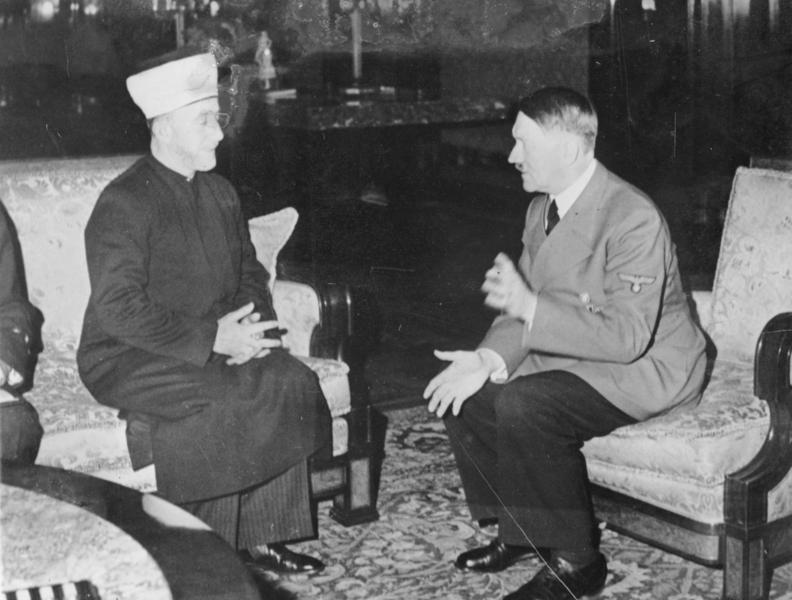
Haj Amin al-Husseini, the Grand Mufti of Jerusalem, later became the most notorious example of this convergence.
Al-Husseini allied himself with Nazi Germany during World War II. From exile in Berlin, he used Nazi radio broadcasts to urge Arab and Muslim audiences to oppose Britain, France and the Jews.
In his role as a political and religious figure, al-Husseini encouraged violence against Jews in British Mandate Palestine. His wartime alliance with Nazi Germany made him a central figure in the history of Nazi-Islamist collaboration.
Nazism and Jihadism Connection
The Nazi-jihadi connection rested on shared antisemitism and hostility toward Western powers.
The two movements did not agree on everything. Nazi racial ideology clashed with many non-European peoples. Islamist movements rejected Nazi paganism and racial doctrine.
But both sides saw Jews as a central enemy.
That shared hatred helped Nazi propaganda move into parts of the Arab and Muslim world. Arabic translations and excerpts of Adolf Hitler’s Mein Kampf circulated in the region before and after World War II.
Another text, The Protocols of the Elders of Zion, played an even wider role. The book first appeared in Imperial Russia in 1903. It claimed to reveal a Jewish plot for global domination.
It was a hoax.
Despite that, antisemites translated and spread the forgery across the world. Nazi propagandists used it. Later extremist movements also used it to feed claims of an international Jewish conspiracy.
Israel has also said its forces found Arabic copies of Mein Kampf during operations connected to Hamas. Such claims underline how Nazi-era antisemitic material still appears in modern Middle East conflicts.
Doctrine Differences
Nazism and jihadism differ in doctrine.
Nazism pursued a racially pure, white supremacist state. Jihadism seeks an Islamic order free from Western influence and secular authority.
But both ideologies present Jews and the West as existential threats. Both use conspiracy narratives. Both exploit anger, humiliation and social isolation.
Both also use propaganda to recruit vulnerable people.
Modern extremists often use polished videos, online networks and emotional messaging. They promise identity, purpose and revenge.
Their tactics can overlap too. Nazis and jihadists both glorify violence. They both target civilians. They both treat terror as a political tool.
The justification differs. Jihadists frame violence as religious duty. Nazis frame violence as racial survival.
The result is often the same: murder, intimidation and social destruction.
In recent years, counterterrorism analysts have warned that extremist movements increasingly learn from each other.
Neo-Nazis and jihadists do not need to share the same final goal to borrow tactics. They study propaganda methods, online recruitment systems and violent attack models.
This makes counterterrorism harder.
Authorities cannot treat extremist ideologies as isolated silos. Antisemitism, anti-Western hatred and violent conspiracy thinking can move across ideological lines.
The convergence of Nazism and jihadism shows why democratic societies need cross-ideological counterterrorism strategies.
The Nazi Party gained support in the 1930s by exploiting Germany’s economic despair, wounded national pride and political instability.
Adolf Hitler used rhetoric and propaganda with ruthless skill. The Nazis blamed Jews for Germany’s economic collapse, portraying them as both capitalist exploiters and communist subversives.
That contradiction did not matter to Nazi propagandists.
The point was not logic. The point was scapegoating.
The Nazis offered simple answers to complex problems. They created a unifying nationalist myth and identified Jews as the enemy.
That propaganda helped turn a political movement into a totalitarian regime.
Iran’s Case
Iran’s 1979 revolution removed Mohammad Reza Pahlavi, the last Shah of Iran, from power.
The Islamic Republic that followed built a regime rooted in clerical rule, revolutionary ideology and fear. Its leaders used religious language to justify political control at home and militant expansion abroad.
Since 1979, Iran has become a major sponsor of anti-Israel and anti-Western militant groups. Several countries accuse the Islamic Republic of training, financing and arming non-state actors, including Hezbollah in Lebanon, Hamas in Gaza, the Houthis in Yemen and Palestinian Islamic Jihad.
Iran’s leaders also built antisemitism into state rhetoric.
Ruhollah Khomeini, founder of the Islamic Republic, popularized the term “Great Satan” for the United States. The phrase “Little Satan” became a common regime insult for Israel.
That language still shapes Iran’s revolutionary message.
On May 26, 2026, Mojtaba Khamenei, the Islamic Republic’s third Supreme Leader, reportedly used a Hajj pilgrimage message to say Israel would not exist within 15 years. The statement echoed earlier threats from Ali Khamenei, who said Israel would not survive another 25 years.
This is why Israel and Western governments see Iran’s nuclear ambitions as more than a standard military threat.
Nazism and jihadism differ in origin, doctrine and final political aims. But their shared antisemitism, anti-Western hostility and willingness to justify mass violence make their convergence impossible to ignore.