Before smartphones, before social media, before every moment of teenage rebellion could be uploaded and judged by strangers, there was another world.
A louder world.
A rougher world.
A world where freedom often looked reckless from the outside, and where an entire generation of kids found belonging in places most adults were afraid to go.
New York Hardcore Generation X
If you grew up in the suburbs north of New York City during the late 1970s, 1980s, and early 1990s, you probably remember it.
If you didn’t live it, it’s hard to explain.
We were Generation X.
The forgotten kids.
The latchkey kids.
The kids who learned early that nobody was coming to save us, entertain us, or understand us.
So we built our own culture.
Bonfires, Kegs and Five-o
On any given weekend, you’d find us gathering at massive bonfire parties deep in the woods, hidden from the roads and far from adult supervision.
Someone always knew somebody who could get a keg.
Music blasted from battered speakers.
The fires lit up faces that would be gone by sunrise. The smell of smoke, beer, and damp earth became part of the memory.
Then someone would yell, “Five-O!”
And suddenly dozens of teenagers would scatter into the darkness like frightened deer, laughing the entire time.
It sounds insane now.
Back then, it was just Friday night.
The dares were legendary.
Nobody had heard the phrase “risk assessment.”
We climbed places we weren’t supposed to climb. We explored abandoned buildings, railroad bridges, tunnels, and construction sites. We treated every warning sign as a challenge.
The Croton Dam became one of those places whispered about among local teenagers.
If you know, you know.
Every generation had its own stories and its own daredevils determined to push their luck.
It wasn’t because we wanted attention.
There wasn’t anyone watching.
We did it because we were young and convinced we were immortal.
New York Hardcore Became Identity
The real religion of our generation, though, wasn’t found at parties.
It was found in clubs.
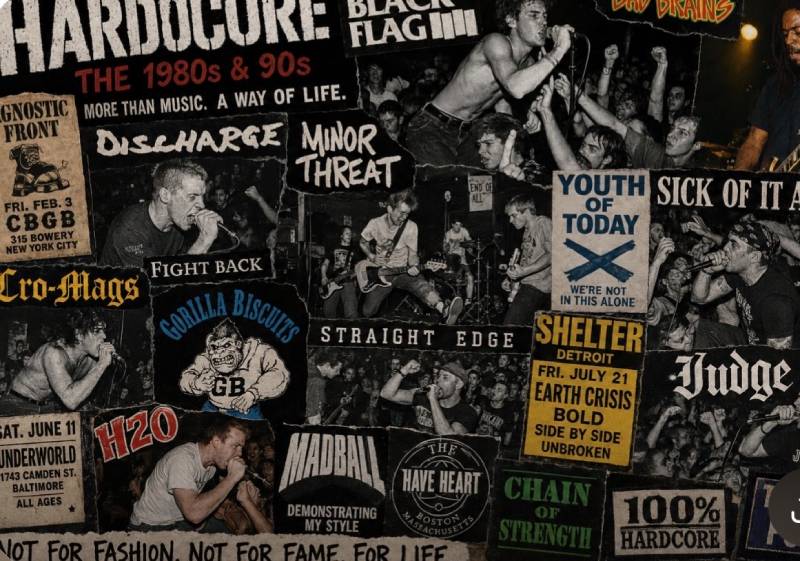
New York Hardcore wasn’t just music.
It was identity.
The movement exploded from New York City’s underground scene in the early 1980s, centered around legendary venues like CBGB and countless smaller clubs scattered throughout the city.
Bands like Agnostic Front, Cro-Mags and Murphy’s Law — and later Biohazard and Madball — became heroes to kids who felt disconnected from the polished, commercial world around them.
The music was fast.
Aggressive.
Honest.
And it reflected the neighborhoods many of us came from.
The New York metropolitan area of the 1970s and 1980s was still wrestling with crime, economic decline, drugs, and urban decay.
Entire sections of the city looked abandoned.
Graffiti-covered subway cars rolled through stations like moving murals.
To adults, the music sounded dangerous.
To us, it sounded true.
The Pit Was Therapy
When the mosh pit exploded, it wasn’t about looking cool.
Nobody in those clubs was trying to become an influencer.
The term didn’t even exist.
The pit was therapy.
A release valve.
Every frustration about school, parents, dead-end jobs, and a future that seemed uncertain got thrown into that chaotic circle.
You stage-dived because you trusted the crowd.
You slam-danced because you needed to burn something out of your system.
You left covered in sweat, bruises, and adrenaline.
And somehow you felt better.
Judged Before We Spoke
Many parents didn’t understand it.
The mid-1980s saw the rise of the Parents Music Resource Center, known as the PMRC, which argued that certain rock and metal albums contained inappropriate themes and messages.
Suddenly, musicians were testifying at congressional hearings, and albums were receiving warning labels.
To many adults, long hair, leather jackets, and aggressive music signaled trouble.
Some genuinely believed their kids were being corrupted.
Many of us remember being judged before anyone even spoke to us.
Teachers assumed things.
Employers assumed things.
Neighbors assumed things.
You could walk into a job interview and watch someone’s expression change the second they saw your appearance.
But that rejection often pushed us closer together.
The scene became family.
Not perfect family.
Not always healthy family.
But family nonetheless.
Subway Rides Home
The nights usually ended with long subway rides home.
Anyone who rode New York’s trains in those years remembers them differently than today.
The cars were covered in graffiti. The stations smelled like steel, dirt, and city life.
At two in the morning, after a show, exhausted kids in leather jackets and band shirts would pile into train cars carrying memories of another night that felt important.
The floors of the clubs were sticky.
The walls were covered in flyers.
The air smelled like cigarettes and weed.
The amplifiers were too loud.
And somehow it was perfect.
Generation X Was Not Lost
Looking back now, it’s easy to romanticize it.
The truth is that not everything was good.
Some people got hurt.
Some friends disappeared into addiction.
Some never escaped the struggles their music reflected.
But there was something genuine about that era that feels increasingly rare.
Nobody was curating an online identity.
Nobody was counting followers.
Nobody was documenting every second for public approval.
The memories exist because we lived them, not because we recorded them.
Generation X often gets overlooked in conversations about American culture.
Maybe that’s fitting.
We were overlooked then, too.
But for those of us who came of age in the suburbs and streets surrounding New York City during those years, the memories remain vivid.
The bonfires.
The clubs.
The subways.
The music.
The friendships.
The freedom.
For a brief moment in time, we weren’t lost at all.
We knew exactly where we belonged.