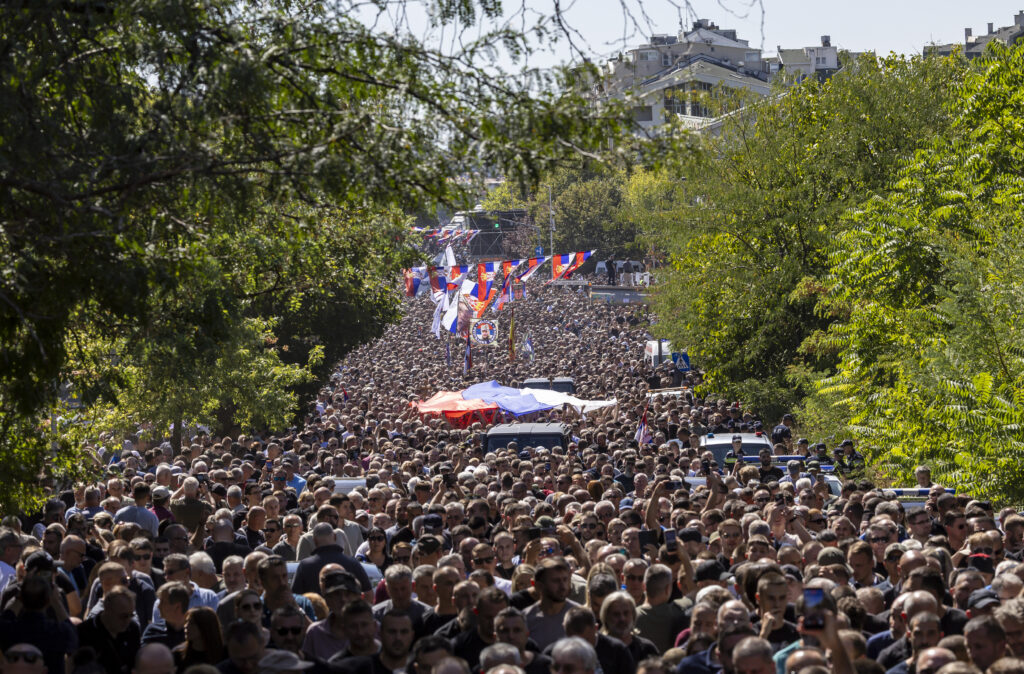
Mladić holds a particular cachet among nationalists who believe Serbs are entitled to more land and power in the Balkans, and not only those aligned with the ruling party. The young men in the funeral procession wore black T-shirts with Mladić’s face across the front, or flags printed with his smiling portrait tied around their shoulders. Others held signs reading “You did not die, General, you live in our hearts.”
Miloš Jovanović, leader of the New Democratic Party of Serbia, an opposition figure who often attacks Vučić from the right, also attended the funeral mass and said that Serbian citizens regard Mladić as “a symbol of freedom [for] Serb people.”
Since Mladić’s death, murals dedicated to him have appeared across Belgrade, while a public wake was organized on Saturday. The football clash Sunday between Serbia’s two largest clubs, Partizan and Crvena Zvezda, opened with a banner bearing his face and the message “Direction Potočari!” — a grim nod to Mladić’s seizure of the eastern Bosnian village where thousands of Bosniaks were summarily executed.
Neighboring Slovenia, Croatia, Bosnia and Herzegovina, and Kosovo have condemned the events. Bosnia — the country most affected by his ethnic cleansing campaigns — filed criminal complaints against figures who have promoted Mladić’s image since his death, an act punishable by law in the country.
For Serbians who have spent years watching Mladić rehabilitated by successive governments into a defender of the Serb people — his crimes watered down or denied in official retellings — the outrage from the EU has arrived far too late.
“It is rather irritating to read statements from foreign actors professing shock that an authoritarian, nationalist regime would instrumentalize the funeral of a convicted war criminal,” said Srdjan Majstorović, chairman of the board of the European Policy Center in Belgrade.