Climate and environment researcher

 Reuters
Last month was the world’s warmest January on record raising further questions about the pace of climate change, scientists say.
January 2025 had been expected to be slightly cooler than January 2024 because of a shift away from a natural weather pattern in the Pacific known as El Niño.
But instead, last month broke the January 2024 record by nearly 0.1C, according to the European Copernicus climate service.
The world’s warming is due to emissions of planet-heating gases from human activities – mainly the burning of fossil fuels – but scientists say they cannot fully explain why last month was particularly hot.
It continues a series of surprisingly large temperature records since mid-2023, with temperatures around 0.2C above what had been expected.
“The basic reason we’re having records being broken, and we’ve had this decades-long warming trend, is because we’re increasing the amount of greenhouse gases in the atmosphere,” Gavin Schmidt, director of Nasa’s Goddard Institute for Space Studies, told BBC News.
“The specifics of exactly why 2023, and 2024, and [the start of] 2025, were so warm, there are other elements involved there. We’re trying to pin those down.”
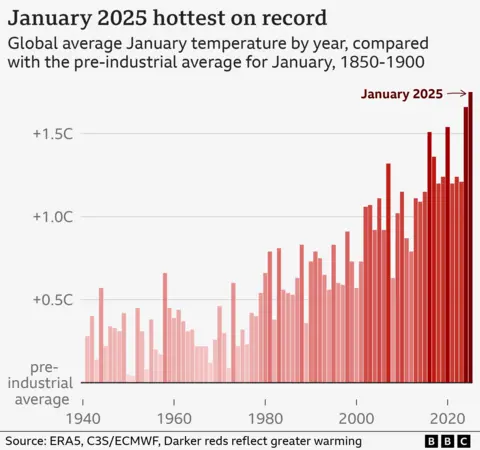
January 2025 ended up 1.75C warmer than January temperatures of the late 19th Century, before humans started significantly warming the climate.
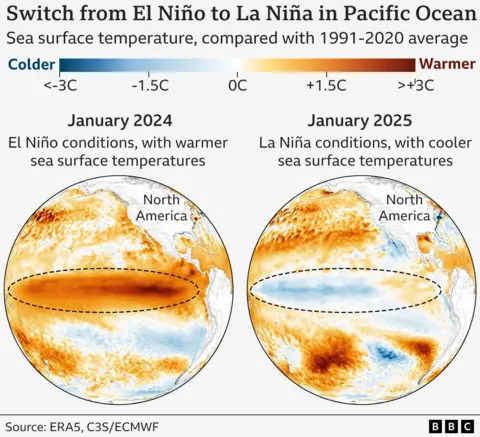
Early last year, global temperatures were being boosted by the natural El Niño weather pattern, where unusually warm surface waters spread across the eastern tropical Pacific. This releases extra heat into the atmosphere, raising global temperatures.
This year, La Niña conditions are developing instead, according to US science group Noaa, which should have the opposite effect.
While La Niña is currently weak – and sometimes takes a couple of months to have its full effect on temperatures – it was expected to lead to a cooler January.
“If you’d asked me a few months ago what January 2025 would look like relative to January 2024, my best shot would have been it would be cooler,” Adam Scaife, head of monthly to decadal predictions at the UK Met Office, said.
“We now know it isn’t, and we don’t really know why that is.”
A number of theories have been put forward for why the last couple of years have been warmer than anticipated.
One idea involves a prolonged response of the oceans to the 2023-24 El Niño.
While it was not especially strong, it followed an unusually lengthy La Niña phase from 2020-23.
The El Niño event might therefore have “lifted the lid” on warming, allowing ocean heat that had been accumulating to escape into the atmosphere.
But it’s unclear how this would still be directly affecting global temperatures nearly a year after El Niño ended.
“Based on historical data, that effect is likely to have waned by now, so I think if the current record continues, that explanation becomes less and less likely,” says Prof Scaife.
The fact that sea temperatures in other regions of the world remain particularly warm could suggest “that the behaviour of the ocean is changing”, according to Samantha Burgess, deputy director of Copernicus.
“We’re really looking to see how the ocean temperatures evolve because they have a direct influence on air temperatures.”
Another prominent theory is a reduction in the number of small particles in the atmosphere, known as aerosols.
These tiny particles have historically masked some of the long-term warming from greenhouse gases like carbon dioxide and methane by helping to form bright clouds and reflecting some of the Sun’s energy back into space.
Aerosol numbers have been falling recently, thanks to reductions in tiny particles from shipping and Chinese industry, for example, aimed at cleaning the air that people breathe.
But it means they haven’t had as large a cooling effect to offset the continued warming caused by greenhouse gases.
And this cooling effect of aerosols has been underestimated by the UN, argues James Hansen, the scientist who made one of the first high-profile warnings on climate change to the US Senate in 1988.
Most scientists aren’t yet convinced that this is the case. But, if true, it could mean there is greater climate change in store than previously assumed.
The “nightmare scenario”, says Prof Scaife, would be an extra cloud feedback, where a warming ocean could cause low-level reflective clouds to dissipate, in turn warming the planet further.
This theory is also very uncertain. But the months ahead should help to shed some light on whether the “extra” warmth over the past couple of years is a blip, or marks an acceleration in warming beyond what scientists had anticipated.
Currently, most researchers still expect 2025 will end up slightly cooler than 2023 and 2024 – but the recent warmth means they can’t be sure.
What they do know, however, is that further records will follow sooner or later as humanity continues to heat up the planet.
“In time, 2025 is likely to be one of the cooler years that we experience,” Dr Burgess said.
“Unless we turn off that tap to [greenhouse gas] emissions, then global temperatures will continue to rise.”
Graphics by Erwan Rivault