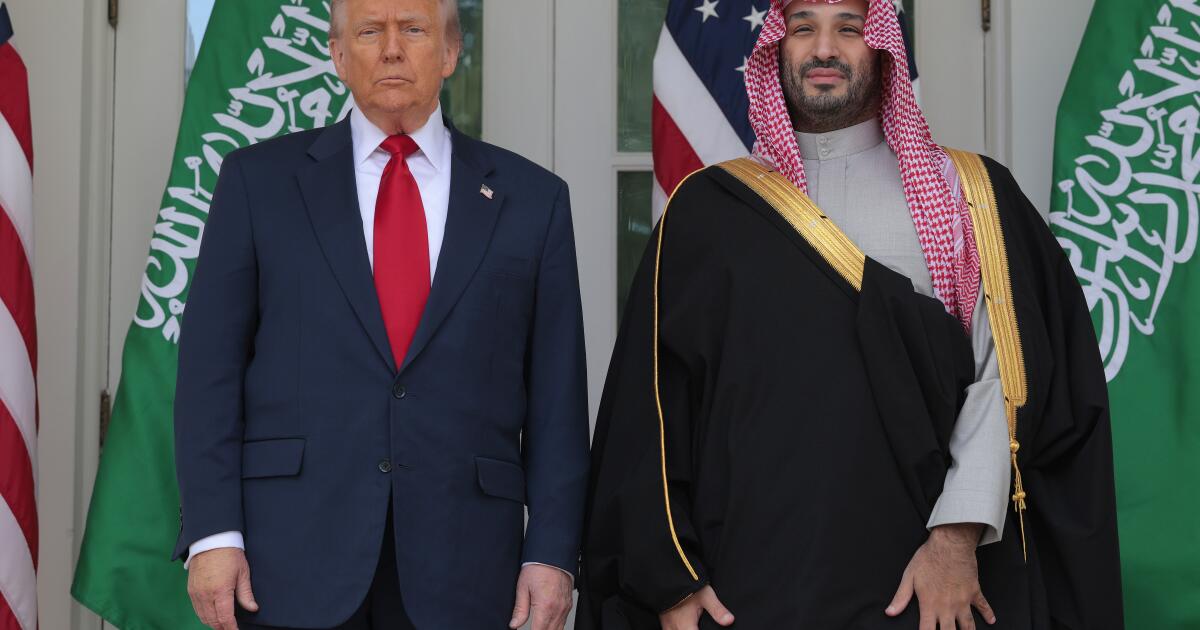
WASHINGTON — The Trump administration has agreed to work with Saudi Arabia to develop a civilian nuclear program, a watershed moment after a years-long effort to curb the proliferation of nuclear technology in the Middle East.
The announcement comes as President Trump has vowed to continue executing a war against Iran over Tehran’s nuclear ambitions. On Wednesday, the president warned he would target a bridge or power plant for every commercial vessel Iran fires upon in the Strait of Hormuz, after earlier this week threatening to strike a new facility Tehran is reportedly building to conceal its continued nuclear work.
The Saudi deal elicited surprise and immediate concern across Washington, where lawmakers are expected to have a vote on the matter, as well as in Israel, a nuclear power that has long feared an atomic arms race could grip the region.
A Saudi nuclear program has long been tied to the standoff over Iran’s nuclear work, which successive U.S. administrations have said extends beyond civilian purposes. After Iran struck a nuclear deal with world powers in 2015, Saudi Arabia vowed to match whatever nuclear capabilities Tehran was allowed to maintain.
In the decade since, U.S. officials have tried to keep Saudi Arabia from developing its own program, fearing it would fuel nuclear competition across the Middle East. But it became a consistent and central point of negotiation between the two allies.
Both the Trump and Biden administrations ultimately offered to support a limited, monitored program as part of a broader deal to normalize relations between Saudi Arabia and Israel, hoping that a diplomatic breakthrough would mitigate the risks of an arms race.
But the agreement secured this week left skeptics in Washington and the region unclear what the United States had secured in return.
Trump administration officials said the deal will “uphold the highest standards of nuclear safety and nonproliferation.” But experts quickly questioned the concessions made in the agreement regarding future inspections of suspected nuclear activities.
Under the agreement, the United States agreed to retreat from an arrangement that provides for more stringent monitoring and inspections — a diplomatic move that could be “potentially disastrous,” said Simon Henderson, the director of the Washington Institute’s Gulf and Energy Policy program.
“It looks like Washington is accepting an undermining of the international nuclear regime in order to have a commercial deal,” Henderson said.
He added that the broader effects of the deal extend to what other countries in the region may seek next.
“If the Saudis get a deal like this, everybody else will want a deal like this, and more nuclear enrichment is bad news for long-term stability,” he said.
The deal comes after Trump told reporters this week that the goal of resuming war with Iran was to prevent it from ever obtaining nuclear weapons, a challenge that has vexed the international community since the outset of the century.
U.S. presidents have long sought to prevent Middle Eastern countries from acquiring technologies that could be used to build weapons of mass destruction. The 2003 invasion of Iraq over false claims about Saddam Hussein’s weapons programs prompted Libya’s Moammar Qaddafi to abandon his nuclear work. Over the next two decades, the United States and Israel also targeted Syria’s nuclear and chemical weapons programs under Bashar Assad.
But Iran’s slow march to nuclear weapons capability, enriching uranium near to weapons-grade with no clear civilian or scientific ends, has prompted other countries in the region to question whether they, too, might need similar capabilities to counterbalance a historical foe. Israel, which views the Islamic Republic and its nuclear program as existential threats, is widely believed to possess nuclear weapons.
Hours after the nuclear deal was reported by the Wall Street Journal, the White House was silent on the details and Trump administration officials were left scrambling when asked by lawmakers and reporters for answers.
Secretary of State Marco Rubio, who was traveling in Manila, told reporters he was aware of the news reports, but deferred to the White House to provide more public information.
When pressed about the risks of such a deal, Rubio said he would not “opine directly on the agreement,” but said the United States “is not going to reach any agreement with any country in the world that leads to the risk of proliferation.”
The White House confirmed the deal Wednesday afternoon.
In Washington, U.S. Ambassador to the United Nations Mike Waltz told members of the House Foreign Affairs Committee that he has not yet seen the agreement with Saudi Arabia.
The deal, which would last 30 years and involve American firms developing the program, is expected to be submitted to Congress for review. Lawmakers will consider the deal as they grow increasingly uneasy about the Trump administration’s handling of an expanding Iran war, which Trump and Israel launched, arguing for the need to wipe out Tehran’s capabilities to build nuclear weapons.
With the war in its fifth month, Trump has continued to defend the military efforts and has dismissed the idea that war is unpopular among Americans as they feel the economic effects.
“Americans aren’t against the war,” Trump told reporters Wednesday. “Americans don’t want high gasoline prices, but they’re not against the war.”
Trump’s remarks were made as he traveled to Dover Air Force Base in Delaware to attend a dignified transfer of U.S. service members killed in the war. Asked what he would say to the families who lost their loved ones, Trump said he’d tell them they’re loved.
“All I’m going to say is, we love you. We love your child, and that’s what they are to them. They’re their children. There’s no games, no nothing,” Trump said. “That’s their child, and all you can do is throw out your heart.”
Earlier in the day, Trump said the United States will destroy a bridge or power plant in Iran each time the Islamic Republic shoots at a ship in the Strait of Hormuz, a crucial waterway for the global energy supply.
Trump’s threat to target bridges and power plants would mark yet another escalation that could affect civilians in the region.
Hasan Ghashghavi, a member of the Iranian parliament’s National Security and Foreign Policy Committee, denied Trump’s claim on Tuesday that Tehran was requesting negotiations, saying in a statement on X that it was “in no way consistent with the facts.”
“It seems that Trump, in order to extricate himself from the quagmire he’s trapped in, should seek better paths,” he wrote. “Repetitive lies no longer even bring about short-term market relief.”
Times staff writer Nabih Bulos in Beirut contributed to this report.