WASHINGTON — The Supreme Court refused Monday to hear an appeal from President Trump seeking to cut off research grants to University of California professors that promote diversity, equity and inclusion.
Without a comment or dissent, the justices turned down the administration’s claim and let stand a 9th Circuit Court ruling that held the cutoff of these research grants violated the 1st Amendment and its protection for free speech.
While not a final ruling, the court’s action is a significant win for the embattled professors and a defeat for Trump.
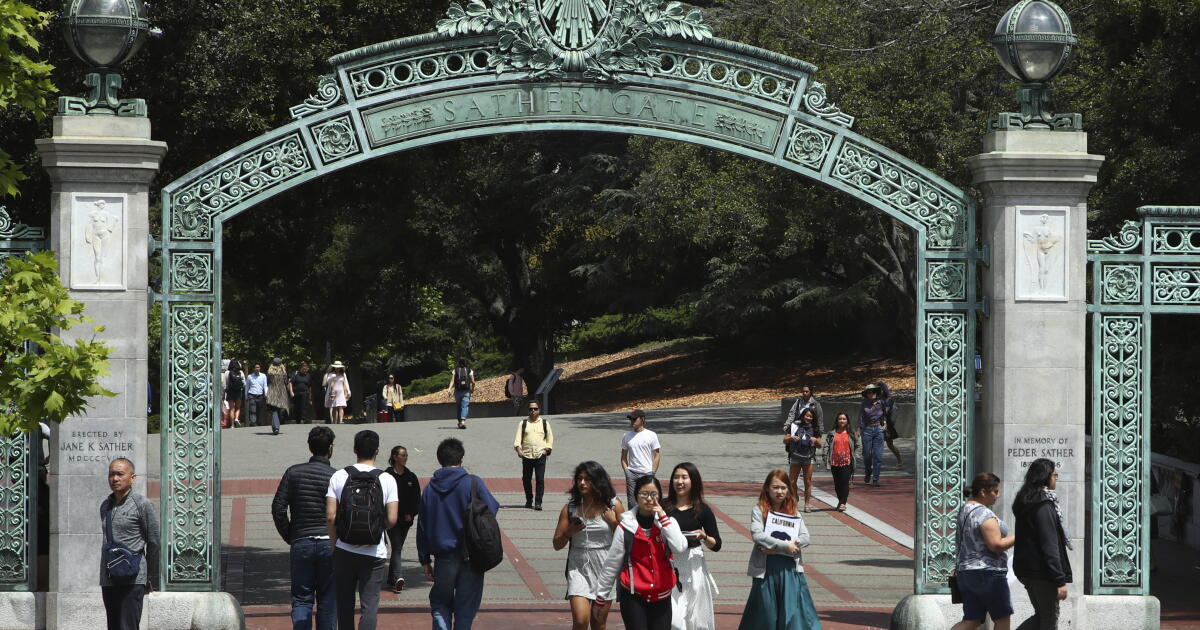
The administration planned to cancel about $150 million in UC research grants that were awarded by the National Endowment for Humanities and the National Science Foundation. It was a small part of a larger fight nationwide that could affect several billion dollars in government grants.
A UC spokesperson said the decision “preserves an important victory for the UC researchers whose critical work and federal grants were targeted. It supports the principle that research funding decisions should be based on merit, not politics.”
Claudia Polsky, a UC Berkeley law professor who represents the researchers, called the court’s decision “very consequential.”
Although the appeal covered only NSF and NEH grants, she said that it has the effect of also protecting hundreds of millions in reinstated UC grants from the National Institutes of Health and the Defense and Transportation departments. Professors also challenged those grant cuts on free speech grounds, with funding restored under a separate order in the same lawsuit.
In seeking Supreme Court review, Solicitor Gen. D. John Sauer, representing the Trump administration, argued the 9th Circuit’s view of the 1st Amendment was wrong and could limit the government’s authority over spending and grants.
He told the court that “vast sums of taxpayer money are at stake. The UC system took in more than $4 billion in federal grant money in 2024,” he said.
“If left to stand, the 9th Circuit’s decision will establish precedent forcing taxpayers to waste countless dollars on private projects promoting ideologies that their public stewards reject,” he wrote.
In response, UC Berkeley Law Dean Erwin Chemerinsky urged the court to deny the appeal. Its past decisions make clear that “ideologically driven attempts to suppress a particular point of view are presumptively unconstitutional in funding,” he said.
When Trump returned to office last year, he issued an executive order “ending radical and wasteful government DEI programs.” He said universities had “adopted and actively use dangerous, demeaning, and immoral race and sex-based preference under the guise” of DEI.
In response, several agencies sent form letters to professors terminating their grants. They did so based on key words in the proposals such as diversity, equity or “environmental justice.”
The canceled grants supported projects including UC Berkeley’s work editing and publishing Mark Twain’s writings and a UCLA study of how information spreads on social media.
The researchers were told their projects no longer fit “agency priorities.”
Six UC professors filed a class-action suit in June 2025 to challenge the terminations. They cited constitutional claims including due process of law as well as a violation of government procedures. The case is named for UC San Francisco researcher Neeta Thakur, whose $1.3-million Environmental Protection Agency grant studied the effect of wildfire smoke on California communities
But the Supreme Court narrowed the claims in different and much larger cases involving health and education grants. It said claims for canceled grants must go to the Court of Federal Claims and cannot be overturned by a federal judge.
Citing those decisions, the 9th Circuit Court in May limited the UC case to a 1st Amendment claim.
The government may not use “its power to punish or suppress disfavored expression,” the appeals court said.
Its judges agreed the government may choose to fund some programs and not others, but they said officials may not discriminate against qualified grant recipients because of their viewpoint.
In August, Trump’s solicitor general urged the Supreme Court to review the case of Trump vs. Thakur and reverse the 9th Circuit’s decision on the 1st Amendment.
It establishes “a dangerous precedent that will hamstring every future administration,” he said.
But the appeal was turned down after consideration for just one week.
The lawsuit that led to Monday’s Supreme Court action has had effects beyond the researchers who originally filed it.
In separate orders in the same case, U.S. District Judge Rita F. Lin in San Francisco restored about $581 million in UCLA research grants in August and September 2025, which the administration froze over allegations of campus antisemitism.
Months after the judge ordered the UCLA grants restored, the Justice Department sued UC, alleging that UCLA tolerated antisemitic harassment of students. The suit seeks repayment of more than $2 billion in research grants. UC has asked the court to dismiss the case.
Savage reported from Washington, Kaleem from Los Angeles.