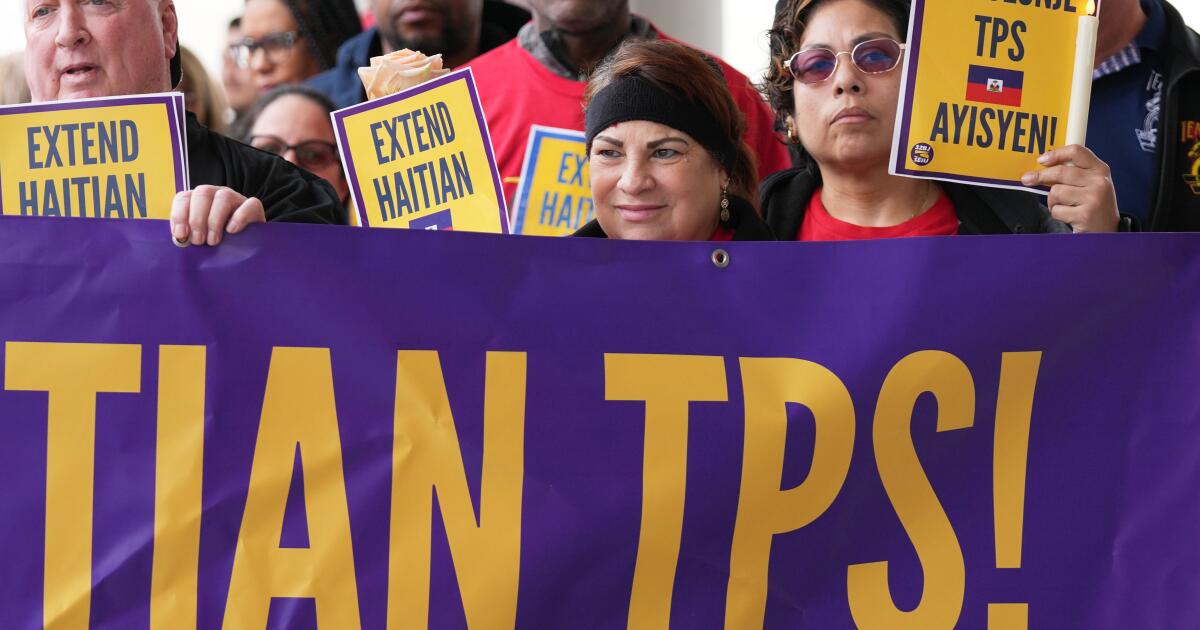
WASHINGTON — The Supreme Court ruled Thursday that the Trump administration may end the Temporary Protected Status granted to more than 350,000 Haitians and Syrians whose home countries remain unsafe.
In a 6-3 decision, the court’s conservative majority said Congress gave the administration, not judges, the power to cancel or renew this temporary protection for noncitizens who are living and working here.
Justice Samuel A. Alito Jr. said the law closes the door to legal challenges when the administration decides to cancel the temporary protection.
It says that “there is no judicial review of any determination of the [secretary of Homeland Security] with respect to the designation, or termination or extension of a designation,” he wrote for the court. “This text is clear, and its plain meaning is very broad.”
TPS holders have registered with the government and passed background checks to gain the protections. Many have been in the country for decades and have U.S. citizen children. They now stand to lose their jobs and could be detained and deported.
The court also ruled for the Trump administration Thursday in a separate immigration case, allowing the government to turn away asylum seekers at the southern border.
Although Thursday’s decision on Temporary Protected Status dealt with Haitians and Syrians, its rationale could affect up to 1.3 million noncitizens. Advocates for immigrants swiftly condemned the decision.
“Today’s decision is unconscionable, egregious and devastating,” said Emi MacLean, senior staff attorney for the ACLU of Northern California, and will leave those noncitizens “at the mercy of the Trump administration’s cruel and lawless deportation machine.”
In 1990, Congress authorized this emergency humanitarian relief for noncitizens whose home countries were racked by armed conflict, natural disasters or other extraordinary disruptions.
Under the law, the Department of Homeland Security may grant this protection for six, 12 or 18 months and renew or extend it for a similar period.
But this legal authority has been under dispute since President Trump returned to the White House last year and targeted people with TPS from 17 countries who were living in the United States.
Trump administration lawyers said the law made clear there was “no judicial review” of the government’s decision to cancel the grant of temporary protection.
However, immigrant rights lawyers argued the government failed in its duty to consult the State Department and assess whether it was safe for migrants to return home.
Repeatedly, U.S. district judges agreed with the challengers and ruled the administration’s decisions were arbitrary and unreasonable. But in nearly every case, the Supreme Court granted emergency appeals from the administration and set aside those orders.
Since TPS was created, the government has ended the protected designation for citizens of 18 countries. Federal officials said that allowing Syrians and Haitians to remain is contrary to national interest.
The Department of Homeland Security, under then-Secretary Kristi Noem, also ended TPS for countries including Honduras, Nicaragua, Afghanistan and Venezuela.
James Percival, the general counsel for Homeland Security, said in a statement that with the two favorable decisions Thursday, the Supreme Court had vindicated the agency twice in one day.
“The T in TPS stands for TEMPORARY, yet many of these designations became de facto amnesty,” Percival said. “This is a win for the rule of law and common sense.”
A 23-year-old gay man from Syria who was a lawsuit plaintiff and was identified in court documents by a pseudonym, Mustafa Doe, said that after he saw the Supreme Court decision, his mind raced with thoughts about logistics.
He said he needed to tell his parents, who are green card holders in the United States; his employer, a global corporation where he manages social initiatives; and his roommate at the Manhattan home he bought and might now have to sell.
Though he has pending asylum and green card applications and can legally keep working, losing TPS means immigration agents could now choose to detain him.
“I’m trying not to get myself to that very dark place of thinking,” he said.
Advocates for the immigrants argue that the administration failed to conduct the required process to properly evaluate each country’s conditions and instead acted on political grounds driven by racial animus.
The Supreme Court majority wrote that decisions to end TPS were not driven by race.
State Department travel advisories for both countries warn people against traveling to either because of the risk of terrorism, kidnapping and widespread violence. But Federal Register notices announcing the terminations said country conditions had improved enough.
Recently released internal documents show that Homeland Security decided to terminate protections for Haitians without any input from the State Department.
Internal emails show that Homeland Security officials sought a recommendation from the State Department ahead of Noem’s early June deadline on whether to extend protections for Haiti. But by June 13, a U.S. Citizenship and Immigration Services project manager wrote in an email that Noem had “elected to terminate Haiti without country conditions from DOS.”
Ahilan Arulanantham, co-director of the Center for Immigration Law and Policy at UCLA, who presented arguments to the Supreme Court for the Syria case, said the decision doesn’t take effect for 32 days, after which Haitians and Syrians are likely to lose their employment authorization.
Arulanantham said the decision “hands to the administration and to the far-right wing of the anti-immigrant movement an important victory” by allowing them to kill off TPS protections without having to go through Congress to change the law.
“The court doesn’t say that what the Trump administration has done in TPS decision-making is lawful,” he said. “It doesn’t say that these decisions comply with the TPS statute. Instead, what it says is that the statute doesn’t give the courts any power to correct illegal decisions.”
Advocates called on Congress to pass legislation that would grant permanent legal status to TPS holders and offer explicit oversight power to courts regarding decisions by the executive branch about the program.
B.B., a 35-year-old Haitian woman who works as a medical coordinator, said she’s now putting her faith in Congress to act. She asked to be identified by her middle and last initials out of concern for her immigration case.
B.B. said she’s likely to lose the job that pays her about $94,000 a year and which she relies on to support her mother and her four children, who are American citizens. She said she also owns three real estate properties and a nail salon, which bring in additional income.
She said she grieved the loss of her legal status even before the Supreme Court’s oral arguments.
“Now we’re going to lower the coffin into the ground,” she said.
Stephen Miller, a top White House aide who is known as the architect of Trump’s immigration agenda, told reporters Thursday that the Supreme Court victory was years in the making, and he celebrated that the government can now remove Haitians from the U.S.
“If you no longer have status in this country, then you’re supposed to be deported,” he said.