WASHINGTON — President Trump hosted the leaders of Ukraine and Israel — two nations at war — at the White House on Tuesday, as Washington’s role in both conflicts reaches a critical stage.
Trump’s meetings with Ukrainian President Volodymyr Zelensky and Israeli Prime Minister Benjamin Netanyahu came as the wars in Ukraine and Iran have recently expanded and overlapped in their footprint.
Over the weekend, Ukraine struck an Iranian cargo ship in the Caspian Sea, an attack condemned by Iranian leaders, who are dealing with their own uncertainty with a broadening war with the United States and Israel.
Both meetings took place in the Oval Office without the presence of reporters, and while few details were disclosed about the discussion, the White House described the sessions as “positive and productive.”
Yet there were signs of discord ahead of Netanyahu’s visit, his eighth during Trump’s second term and the first since the start of the U.S.-Israel war on Iran on Feb. 28.
In an interview with Fox News on Tuesday morning, Trump was asked about reports that Netanyahu planned to present him with intelligence about new activity at Pickaxe Mountain, a suspected underground nuclear site in Iran.
“Well, I don’t need Bibi to tell me that. Bibi is telling me that because he wants me to stay involved,” Trump said, using Netanyahu’s nickname. “We know exactly what is going on.”
Trump seemed frustrated that Netanyahu was putting out that information ahead of the meeting, but added that the United States would “take out Pickaxe if we don’t make a deal.” Netanyahu also came into the meeting with Trump as he pursues campaigns in Gaza, Lebanon and Syria, all with the backdrop of intensifying unrest across the Israeli-occupied West Bank.
Following the meeting, however, Netanyahu issued a video statement insisting the two had an “excellent” session.
“It was one of the best conversations I’ve had with our friend, U.S. President Trump,” Netanyahu said, adding that Israel and the U.S. were meeting “with full cooperation, with mutual support, with understanding on the joint goal that Iran won’t have nuclear weapons, and also other goals.”
With Zelensky, there were fewer signs of strain, showing improved relations between the two leaders, at least compared with their first meeting last year, which devolved into a shouting match in the Oval Office in front of television cameras.
In a social media post, Zelensky described his meeting with Trump as “good,” and thanked him for working with him to “protect the lives of Ukrainians and advance peace.”
Zelensky said the two leaders discussed Trump’s pledge to allow Kyiv to produce U.S. Patriot air defense missiles, which are vital in its military efforts against Russia.
“We also spoke about diplomacy,” Zelensky said in an apparent reference to Trump’s interest in helping Ukraine and Russia reach a peace deal.
Trump’s relationship with Zelensky has shown signs of improvement since the start of the Iran war, as Ukraine has helped Americans with drone technology to use in the Middle East conflict.
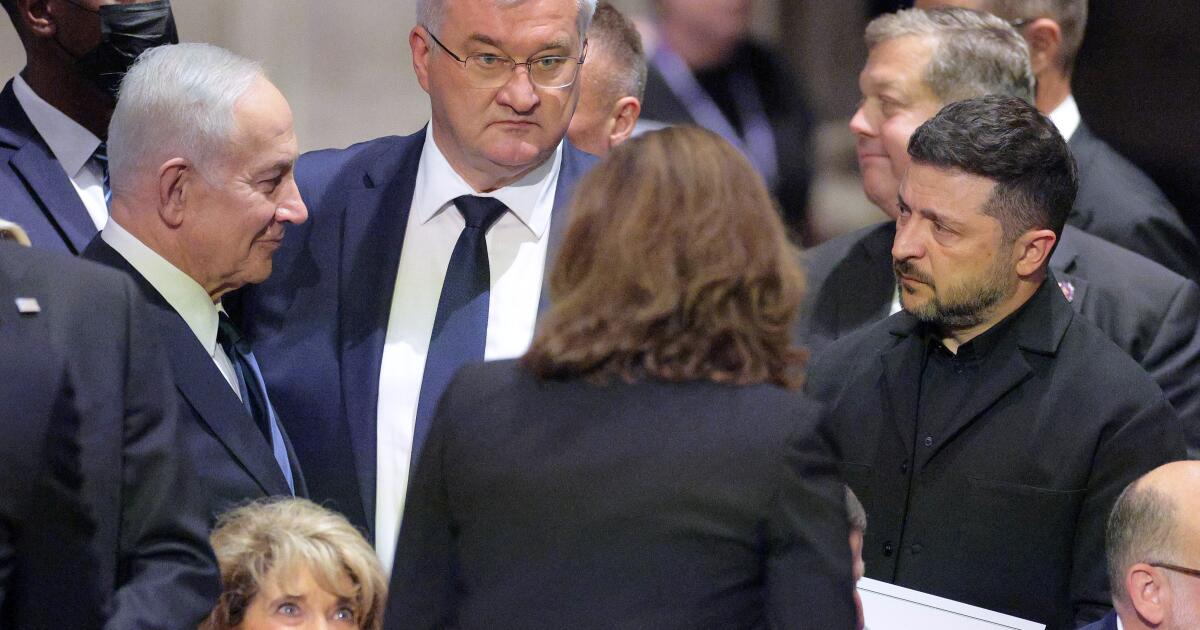
Following the meetings, all three men attended the funeral of Sen. Lindsey Graham, the South Carolina Republican who up until his death on July 11 was a staunch supporter of both Ukraine and Israel.
Zelensky was also scheduled to meet with a group of senators at the U.S. Capitol on Tuesday evening to talk about legislation that would impose harsher sanctions on Russia and its trading partners. Graham was an author of the proposed measure.
In recent days, Israeli settlers have ramped up attacks on Palestinian towns and villages, vandalizing properties, commandeering homes and fields, and establishing settlements that are illegal under international law.
At the same time, Israeli soldiers have intensified their incursions across the West Bank, arresting more than 100 Palestinians and demolishing homes.
The escalation followed a clash between settlers and Palestinian residents Friday that turned lethal, killing four Palestinians and two Israelis in what was considered the deadliest single attack in the West Bank this year.
Israeli attacks have also persisted in Gaza despite a ceasefire signed nine months ago. On Tuesday, health authorities in the enclave said 22 Palestinians were injured in Israeli strikes.
The rise in hostilities comes as Israel continues to push the United States to press on with a conflict that experts say carried political risks for the Trump administration with its supporters at home and international allies.
Last week, the U.S. war escalated again as Iran-backed Houthis in Yemen attacked two Saudi Arabian oil tankers in the Red Sea, causing global oil prices to surge. The development prompted fears of yet another vital energy corridor being choked off by the Iran war.
As the November elections approach, Trump has downplayed the economic toll the war has taken on his supporters. On Monday, he told a crowd in Michigan that if they ever question why the United States is at war, it’s because “we’re not going to let lunatics have a nuclear weapon.”
Meanwhile, the cycle of claims and counterclaims by the U.S. and Iran has continued.
On Tuesday, Ebrahim Zolfaqari, a spokesperson for the unified command of Iran’s armed forces, warned any country or company accepting frozen Iranian funds as compensation for damaged vessels — as per Trump’s proposal over the weekend — would be struck.
Iran’s Foreign Ministry spokesperson Esmail Baghaei also contradicted Trump’s assertions of ongoing discussions between Iran and the U.S. and that Tehran was asking for a meeting.
Negotiations with the U.S. are “not in our DNA,” Baghaei said.
Meanwhile, Ukraine’s strike on an Iranian ship has raised the possibility of a growing footprint in that war. Ukraine said the ship was carrying military equipment between Iran and Russia.
Iran condemned the attack, with Iranian Foreign Minister Abbas Araghchi slamming it as a “violation done at Israel’s behest” and the ministry spokesman comparing Zelensky to pre-World War I “anarchists” whose “theatrical yet highly dangerous acts” ignited a Europe-wide conflict.
“There is no guarantee that a dramatic gesture intended to attract attention and assert one’s position in the international arena, where that position is not particularly strong, will remain limited in scope,” Baghaei said during a news conference in Tehran on Monday.
He added: “The consequences, both for Ukraine and for the entire region drawn into this conflict, could be unpredictable.”
Ceballos reported from Washington and Bulos from Beirut.