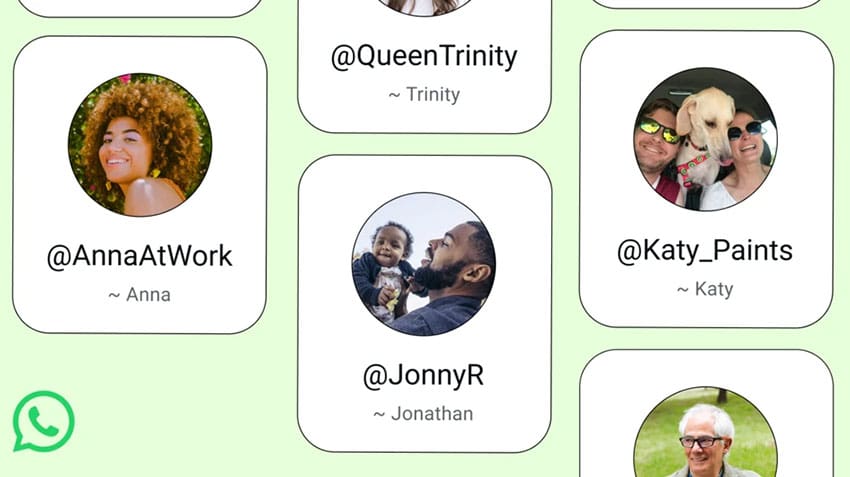
WhatsApp is preparing to let its users start conversations without handing over the one piece of information most of us would rather keep to ourselves: our mobile number.
Instead, the Meta-owned messaging service will allow people to connect by exchanging unique usernames, a change that brings the world’s most-used chat app into line with rivals that have offered the feature for years.
The roll-out is being staged globally across WhatsApp’s three billion account holders over the coming months. From this week, users can begin reserving a name through the app, although doing so will not be compulsory. The company says people will be able to remove or change their username at any time, and that once the system is fully switched on, two users will be able to connect having shared nothing more than their handles. The familiar options to block or report unwanted contacts will remain in place.
How the new system works
Names will be capped at 35 characters, with relatively few restrictions beyond a carve-out for some high-profile officials and celebrities, whose names will be ring-fenced so they cannot be claimed by impersonators. In other words, WhatsApp is unlikely to be flooded with users styling themselves as Donald Trump.
Meta is framing the move squarely as a privacy feature. Alice Newton-Rex, WhatsApp’s head of product, said she had heard repeatedly from users who did not always want to share their phone number simply to stay in touch, particularly within group chats. She said she hoped the change would “give users control over how they choose to show up” on the app.
The handles will be introduced “gradually over the coming months”, according to Meta, with users notified once their username goes live. Anyone wanting to get ahead can reserve a name now through their account or profile settings, where the option to claim a handle will appear as it becomes available.
For founders and owner-managers, there is a useful wrinkle. Creators, small businesses and organisations will be able to claim the username they already use on Instagram or Facebook, keeping their identity consistent across Meta’s estate. Everyone else who wants their WhatsApp handle to match those on other Meta apps will need to link their existing accounts through Accounts Centre, which in turn means some data, across services such as Threads and Messenger, is shared between those accounts. It is a trade-off worth understanding before you tick the box.
Some users have already grumbled on social media that the option to reserve a name has yet to appear for them. The company’s advice is straightforward: make sure you are running the latest version of the app and keep checking.
A familiar idea, finally arriving
WhatsApp is not breaking new ground here. The encrypted messaging app Signal introduced an almost identical feature in 2024, and the broader direction of travel, away from the phone number as a universal identifier, has been building for some time.
That context matters when weighing the privacy claims. “It is a good feature, but even if it does offer more privacy, remember WhatsApp is not a privacy-friendly app overall,” said Carisa Véliz, a professor at the University of Oxford and author of Privacy is Power. “It collects much metadata about users for marketing purposes. We have to remember that WhatsApp is owned by Meta, one of the tech companies with the worst track records when it comes to privacy.”
The distinction is an important one for any business relying on the platform. WhatsApp does not use the content of private chats for advertising; those messages are protected by end-to-end encryption, so the company cannot read them. It does, however, draw on other data, such as your general location and basic account details including age, to support advertising, a model explored in our coverage of Meta’s wider use of automation and user data.
Once the feature is fully live, individual phone numbers will no longer be visible inside WhatsApp. There will be no public username directory, and a phone number will still be needed to open an account in the first place. The handle changes who can find you, not whether you exist on the network.
The scam question
The obvious worry is that easier, number-free contact could hand fraudsters a fresh route in. Asked on X about safeguards, the company pointed to “multiple layers of defence”. Chief among them is an optional username key, a short numbered code that means someone can only message you if they hold both your username and that key, a detail confirmed by security outlet BleepingComputer. WhatsApp adds that its systems “detect and block abuse patterns” automatically, an approach SecurityWeek notes is designed to limit unsolicited first contact.
For SME owners who increasingly run customer service, bookings and sales through the app, the username key is the setting to watch. Used well, it offers a way to stay reachable to genuine customers while keeping the door shut to opportunists.
The platform’s minimum age remains 13, and messaging apps will sit outside the UK’s incoming social media restrictions for under-16s, due to take effect next year, a regulatory backdrop that has already drawn scrutiny in the debate over whether stricter rules could push encrypted services out of Britain and in earlier criticism of the app’s age policies.
New name, new boss
The username launch also lands during a change at the top. WhatsApp recently confirmed that Kunal Shah, founder of an Indian fintech start-up, will take over as head of the platform, with Will Cathcart stepping down after seven years in charge.
For now, the message to users and businesses alike is to reserve early, weigh up the Accounts Centre trade-off, and treat the username key as a feature rather than an afterthought. Whether it materially improves privacy or simply repackages it, the days of the phone number as your sole identity on WhatsApp look numbered.