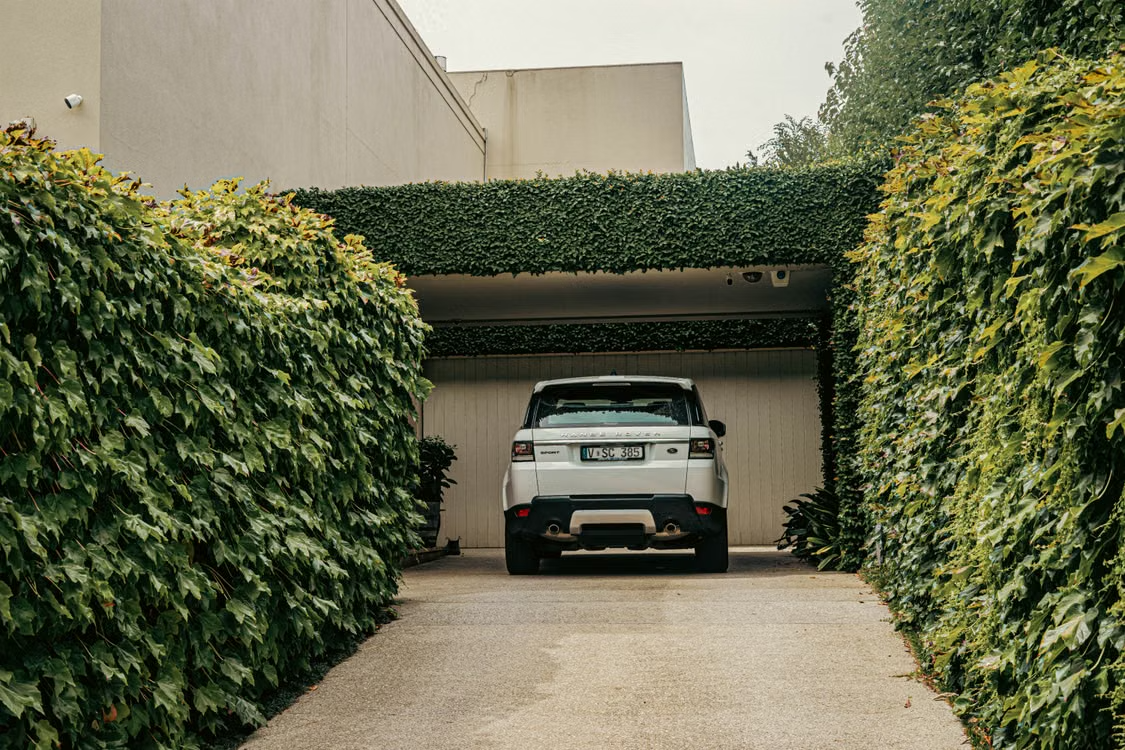
If you live in Melbourne, there is a good chance you have seen it happen.
The side of the driveway that barely gets any sun develops a green tint. The paving beside the house becomes darker than the section near the street. A once-light concrete path slowly turns grey or almost black around garden beds and drainage areas.
Then summer arrives, everything dries out, and the problem looks less obvious.
Until it rains again.
What looks like an ordinary dirty driveway is often the result of a very Melbourne combination: regular rainfall, long cool periods, shaded outdoor areas and the porous materials used extensively around Victorian homes.
And once you understand why it happens, those oddly satisfying pressure-washing transformations make considerably more sense.
Melbourne Doesn’t Need Tropical Rain to Create Damp Outdoor Surfaces
Melbourne is hardly known as Australia’s wettest city.
But total rainfall tells only part of the story.
Bureau of Meteorology long-term climate data for Melbourne records roughly 648 mm of mean annual rainfall and around 100 days each year with at least 1 mm of rain at its long-running Melbourne station. During the cooler months, average daily sunshine falls to around four hours or less in June and July.
That distinction matters around a house.
A torrential summer storm followed by a hot sunny day can allow a driveway to dry quickly. Repeated smaller rain events during Melbourne’s cooler, lower-sunlight months can leave protected areas damp for much longer.
Think about the southern side of a Melbourne home.
Or the narrow strip between the house and boundary fence.
Or the paving underneath established trees.
Or the section of driveway beside a garden bed that receives almost no direct winter sun.
Those are often the areas that discolour first.
Mould itself is not some unusual contamination introduced to a property. Fungi and their spores occur widely in the environment, indoors and outdoors. Given suitable moisture and surface conditions, visible growth can develop. citeturn485977search24
So when green, brown or black patches appear outside, endlessly sweeping the area is unlikely to address everything causing the discolouration.
Then There’s the Way Melbourne Homes Are Built
Walk through Melbourne’s suburbs and you quickly notice how much masonry there is.
Old red-brick houses.
Post-war brick homes.
Brick-veneer suburbia.
Concrete driveways.
Exposed aggregate.
Bluestone.
Concrete and masonry pavers.
Rendered walls.
Modern homes may look completely different from their 1960s neighbours, but hard mineral surfaces remain everywhere.
There is data behind that observation too. A CSIRO housing survey found brick veneer was the main external wall material for 47% of Victorian participants, substantially higher than the corresponding Western Australian sample.
Around the home itself, concrete and pavers are ubiquitous because they are durable—but durable does not mean non-porous or maintenance-free.
Tiny irregularities and pores in an outdoor surface can hold moisture and trap fine particles. Add leaves, soil, vehicle residue, airborne dirt and shaded conditions, and the colour you remember when the driveway was first installed can gradually disappear beneath years of accumulation.
It is usually so gradual that homeowners don’t notice.
Until somebody cleans half of it.
Melbourne’s “Four Seasons in a Day” Reputation Isn’t Great for Outdoor Surfaces Either
The cliché exists for a reason.
Melbourne’s outdoor surfaces regularly move through periods of wetting, drying, cold and significant summer heat.
For context, the Bureau of Meteorology recorded 572 mm of rainfall in Melbourne during 2025, very close to its long-term average. Yet during that same year Melbourne’s Olympic Park reached 39.8°C in January, while its coolest June day peaked at only 10.1°C. citeturn485977search29
A driveway therefore isn’t sitting in one stable environment.
It is exposed to rain, UV, temperature changes, leaves, cars, garden runoff and daily foot traffic year after year.
That is also why “just blast it with the strongest pressure washer you can find” isn’t particularly good advice.
Here’s Where Pressure Washing Gets Misunderstood
Pressure washing videos are incredibly satisfying because the result looks instantaneous.
Dark concrete.
One pass of the surface cleaner.
Bright concrete.
Repeat.
But pressure is only one part of the cleaning process.
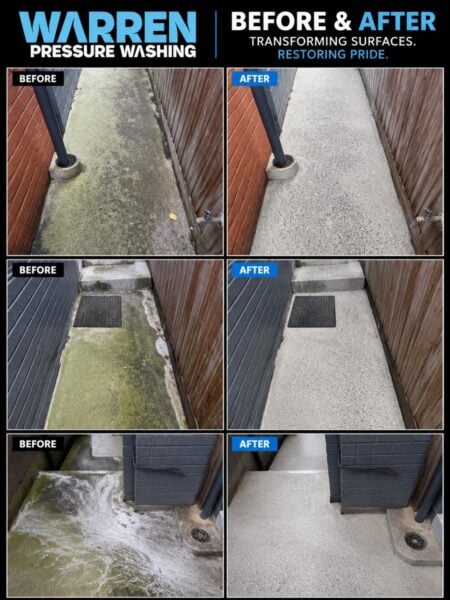
At Warren Pressure Washing by Josh Warren, for example, the cleaning method is adjusted according to the surface. Warren Pressure Washing describes using high-pressure cleaning on durable materials including concrete, stone, tile and pavers, while using different methods where a surface requires more care.
This distinction becomes particularly important in Melbourne because not every “old-looking” surface should be treated the same way.
A modern concrete driveway is one thing.
A weathered timber deck is another.
So is painted render.
And an old Melbourne brick wall is another category again.
Heritage Victoria’s technical material on masonry is a useful reminder that the condition and composition of masonry matter when water and pressure are involved. Its conservation guidance warns, in a different masonry-treatment context, that excessive pressure can damage weak mortar. citeturn485977search9
The takeaway for an ordinary homeowner is simple:
You clean the surface you have, not the pressure-washer setting you have.
The Melbourne Surfaces That Usually Produce the Biggest Before-and-After
Driveways naturally get the attention.
They are large, highly visible, and exposed to vehicles every day.
But some of the most dramatic transformations are actually around the edges of the house.
Shaded pavers
Pavers beside fences, gardens and entertaining areas can darken significantly because they are often slower to dry.
Pool surrounds
Water exposure, landscaping and foot traffic converge in one relatively small area. Surface choice also matters because aggressive cleaning isn’t appropriate for every poolside finish.
Concrete paths
These tend to be ignored until the difference between exposed and sheltered concrete becomes unmistakable.
Outdoor entertaining areas
Melbourne homes increasingly blur the line between indoors and outdoors, meaning the patio or deck is effectively another living space. Dirt, food residue, weather exposure and organic growth all accumulate there.
Driveway edges
The centre of the driveway may stay relatively clean while the edges near grass and landscaping turn dramatically darker.
Those differences are precisely why Warren’s Instagram before-and-after jobs are more useful than generic stock photographs. They show what actually happens to Melbourne residential surfaces rather than an immaculate American-style driveway being sprayed for an advertisement. Warren’s own project gallery includes Melbourne driveway, timber, mould-control, garage and poolside cleaning work. citeturn611826view2
Should You Pressure Wash a Melbourne Home Every Year?
There isn’t a useful one-size-fits-all answer.
A sunny exposed concrete driveway in one suburb may stay presentable far longer than shaded paving underneath dense trees somewhere else.
Instead of cleaning according to the calendar, it makes more sense to watch the property itself.
Look for:
- obvious green or dark organic growth;
- concrete becoming progressively darker;
- slippery-looking shaded paths;
- tyre and oil staining;
- pavers losing their original colour;
- staining around garden edges;
- discolouration that remains after ordinary hosing.
Warren’s own guidance uses annual driveway cleaning as a general starting point while noting that heavily soiled and high-traffic areas can require more frequent attention. citeturn611826view1
But a professional assessment becomes more useful when you have older masonry, timber, coatings, damaged concrete or a surface you cannot confidently identify.
Sometimes the Most Dramatic “Home Improvement” Is Already There
Melbourne homeowners spend enormous amounts changing properties.
New landscaping.
New paving.
Exterior paint.
Driveway resurfacing.
Deck replacement.
Yet accumulated grime can alter our perception of a surface surprisingly quickly.
A faded-looking paved courtyard may still have years of useful life.
A grey driveway may actually be considerably lighter underneath.
A timber entertainment area may need cleaning and restoration rather than replacement.
That does not mean pressure washing repairs failed concrete or reverses structural deterioration. It doesn’t.
But cleaning a surface before deciding what to replace gives you a much better idea of its genuine condition.
Warren Pressure Washing goes beyond cleaning for exactly this reason, offering sealing, painting, timber staining and surface restoration in addition to high-pressure cleaning.
Choosing a Pressure Washing Company in Melbourne Is Really About Knowing What Not to Blast
There are plenty of Pressure Washing Companies in Melbourne, and powerful equipment is not particularly difficult to advertise.
The more useful question is:
Does the operator know how your surface should be treated?
When comparing providers of high pressure washing services, ask about the material rather than simply asking how much pressure their machine produces.
What is the driveway made from?
Is it sealed?
Are there existing coatings?
Is that black patch organic growth or staining?
Could the timber tolerate high pressure?
Is the brickwork old or deteriorated?
Should the area be pressure washed, chemically treated, soft washed, restored or sealed afterwards?
Those questions tell you far more about a provider than PSI alone.
For homeowners trying to find the best pressure washing service in Melbourne, the strongest sign is not necessarily the biggest machine. It is someone who understands Melbourne homes, knows how different materials respond, and can explain why they are choosing a particular treatment.
Because ultimately, the goal isn’t to pressure wash your house.
It’s to clean the right surface, with the right process, without ruining what you’re trying to restore.
And in a city filled with brick, concrete, pavers, timber, shade, rain and very changeable weather, that distinction matters.