Author
Ahmed Barakat
Author

Share

Fact Checked by
CryptoNews Editorial Team
Author

The XRP Ledger (XRPL) is in the news as it released an emergency security patch on September 25 after developers discovered a critical vulnerability that could have allowed attackers to create approximately 18.5 trillion spendable XRP in a theoretical exploit scenario. The potential amount vastly exceeded the network’s original 100 billion XRP supply.
The bug was confirmed on September 22, and the fix was merged the following day. The emergency update, included in xrpld version 3.4.1, addressed a payment-engine overflow that could have undermined the ledger’s XRP supply safeguards. Developers chose to release the patch directly rather than wait for the network’s standard amendment process, which normally requires validators to vote on protocol changes before activation.
That decision reflected the potential severity of the flaw. Waiting for the usual process could have given attackers more time to exploit the vulnerability, particularly if publicly available code revealed how the exploit worked.
However, bypassing the standard activation sequence introduced a temporary risk. Servers running different software versions could process the same exploit transaction differently while validators are upgraded. According to Veria, more than 80% of validators had upgraded by September 25, reducing the period of exposure.
Earn $50 and Enter $300K Prize Draw on EdgeX
XRPL Governance Process
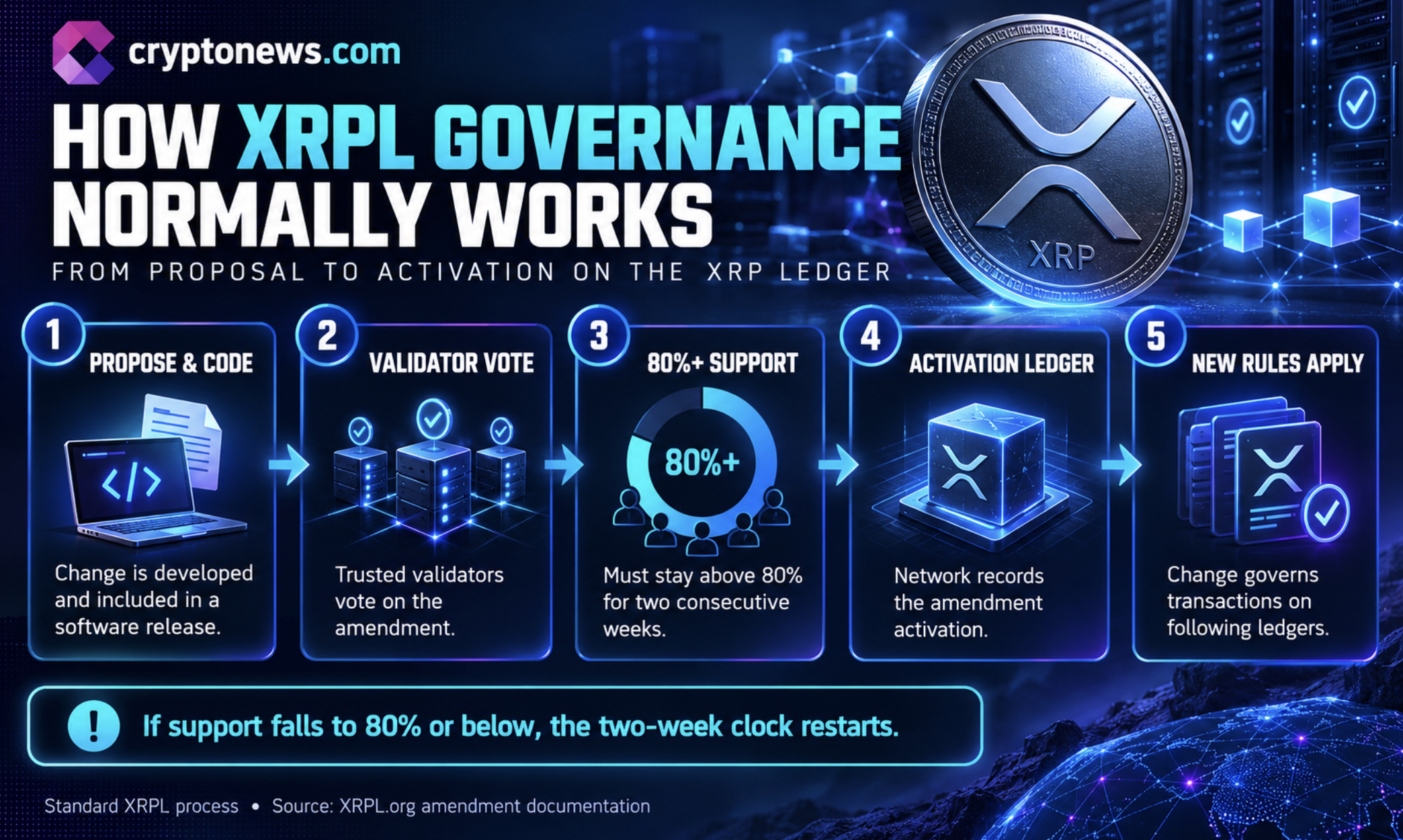
Under XRPL’s usual governance process, validators vote on transaction-processing changes over several weeks before a new rule activates. This approach provides a coordinated transition across the network. Pending XRPL amendments illustrate how protocol changes ordinarily progress through validator support.
The incident also exposed the risks associated with legacy blockchain code. According to Veria, the vulnerable BookStep aggregation code dated back to 2015, while the XRPNotCreated invariant had been present since 2017. Both code paths had remained in the software for years before the vulnerability was identified.
The discovery also raises questions about the growing role of artificial intelligence in cybersecurity. AI-assisted tools can help researchers uncover dormant vulnerabilities in established software, but they can also lower the effort required for attackers to identify exploitable weaknesses.
Ultimately, the XRPL patch addressed a potentially serious threat without evidence of exploitation on a public network. Although the theoretical 18.5 trillion XRP figure illustrates the vulnerability’s potential scale, it does not mean those tokens were actually minted.
The episode nevertheless leaves an important question for the ecosystem: how should decentralized networks balance emergency security responses with transparent, validator-driven governance?
Trade XRP on Bybit and Get a Chance to Win Our $1,000 USDT Airdrop
XRP News: Why XRPL Skipped Its Amendment Route
Under the usual process, validators vote on changes to transaction processing over several weeks before the new rule activates. That process gives the network a coordinated point of transition, and pending XRPL amendments illustrate how protocol changes ordinarily move through validator support.
For this fix, however, publishing the code ahead of activation could have shown attackers how to exploit the still-vulnerable network. Developers instead released the emergency patch directly, making it effective on each server as it upgraded.
The XRPL Foundation’s vulnerability disclosure report describes the payment-engine overflow and the decision to ship without waiting for the usual amendment route.
The exception carried a trade-off: servers running different versions could process the exploit transaction differently during the upgrade window.
The fix did not establish a new normal for XRPL governance. It was an emergency response to a vulnerability that, if exploited, could have created spendable XRP at a scale far beyond the original supply
Veria’s proof of concept used specially priced offers and spread the resulting XRP across multiple accounts, keeping each account below the ledger’s individual balance limit. The firm estimated the theoretical exposure at about $94 billion.
The reported timeline in this XRP news was compressed: the bug was confirmed on September 22, the fix was merged on September 23, and xrpld 3.4.1 was released on September 25. RippleX found no evidence that the vulnerability had been exploited on a public network.
Discover: The Best Token Presales