The Times submitted surveys to the candidates. Unedited excerpts from the surveys, in which candidates lay out detailed goals and policy analysis, can be found at the links below.
Aligned with their parties
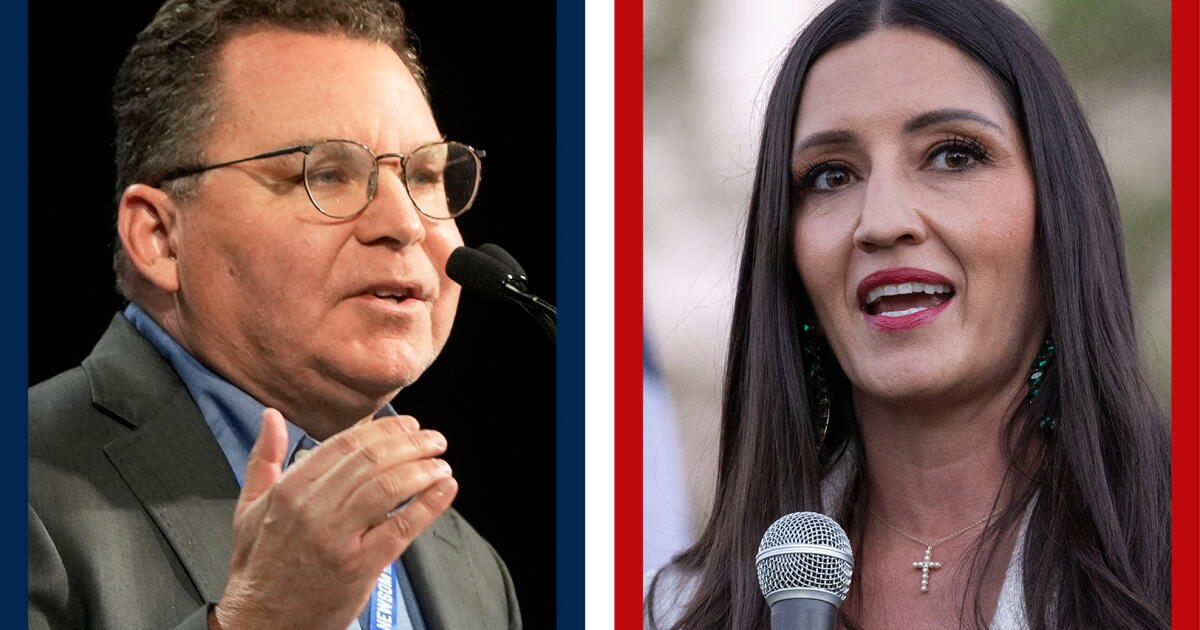
Shaw, 44, is the president of the Chino Valley Unified Board of Education, overseeing a relatively large school system of 26,000 students in San Bernardino County.
Barrera, 59, is the president of the San Diego Unified Board of Education, which governs the state’s second-largest school system with about 113,000 students. Barrera also serves as a senior adviser to state Supt. Thurmond, whom Shaw has sharply criticized.
Both are parents. Barrera’s children are grown; Shaw’s still are in school.
Shaw broadly characterizes the public education system as failing because of liberal Democratic policies, although she praises the quality of the public school system over which she presides. On the culture-war front, she supports flag bans at schools — which were conceived to target gay pride flags — and book restrictions that target content deemed as sexually obscene.
She became politically activated by the pandemic’s prolonged school closures, COVID vaccine mandates and mask mandates — all of which she opposed.
Despite a consistent policy alignment with the Trump administration, Shaw, a longtime religious conservative and a small business owner, objects to any implication that she is falling into line behind Trump or that she is subservient to his policies.
“I don’t put loyalty behind a person,” Shaw said. “I put my my effort and my love and my everyday sacrifice behind protecting kids, whether it’s this president, the next president or whatever. If they’re on the right side of protecting kids, then, of course, when it comes to the issues, I’m all in. I really honestly hate the division. In my heart, if we just speak on our issues, it’ll bring people together. We could see more eye to eye. We can actually have decent conversations, right?”
At times, Shaw presents a sharp rhetorical style, as when she characterized a September court ruling that placed limits on when school officials would have to notify parents about their child’s gender issues. Shaw believes such notifications should be mandatory. Her first emphatic comment, in an interview and a social media post after the hearing, which she attended, was: “Kangaroo courts. Dishonorable judges.”
Shaw sidesteps discussions about Trump’s immigration enforcement. “Districts should follow the law, communicate clearly with families and keep their attention on the classroom … That’s where our energy belongs,” she said.
Barrera, in contrast, calls Trump’s immigration raids harmful.
“This assault on our immigrant families by the Trump administration absolutely is a real issue that affects students and affects educators,” he said. “And I’m going to stand up to those assaults, and Californians will continue to stand up to those assaults.”
Barrera defends the quality of public schools and advocates for increased funding and expanding what works from successful campuses to those with poorer academic results.
Barrera sees the superintendent as a convener and organizer to advance initiatives that benefit students — with or without state funding or direction from the governor and Legislature.
As an example, he cited the education department’s effort to promote affordable workforce housing projects on school district property. He also cited efforts to reduce chronic absenteeism, for which the department gathered a working group that has produced guidance for schools.
Barrera has a long career in community and labor organizing and worked as a senior official in two unions. That background, combined with his 18 years on the San Diego school board, where he has been a union ally, made him an ideological fit with CTA. Neither Barrera nor CTA had to compromise values or shift positions to join forces for this campaign.
“I have absolute respect and … a long demonstrated partnership with the unions that represent our educators,” Barrera said, “and believe strongly that unions are democratically elected, governed institutions where the educator voice comes out most powerfully, and so for me, the unions are a partner and will always be a core voice in influencing the way that I make decisions.”