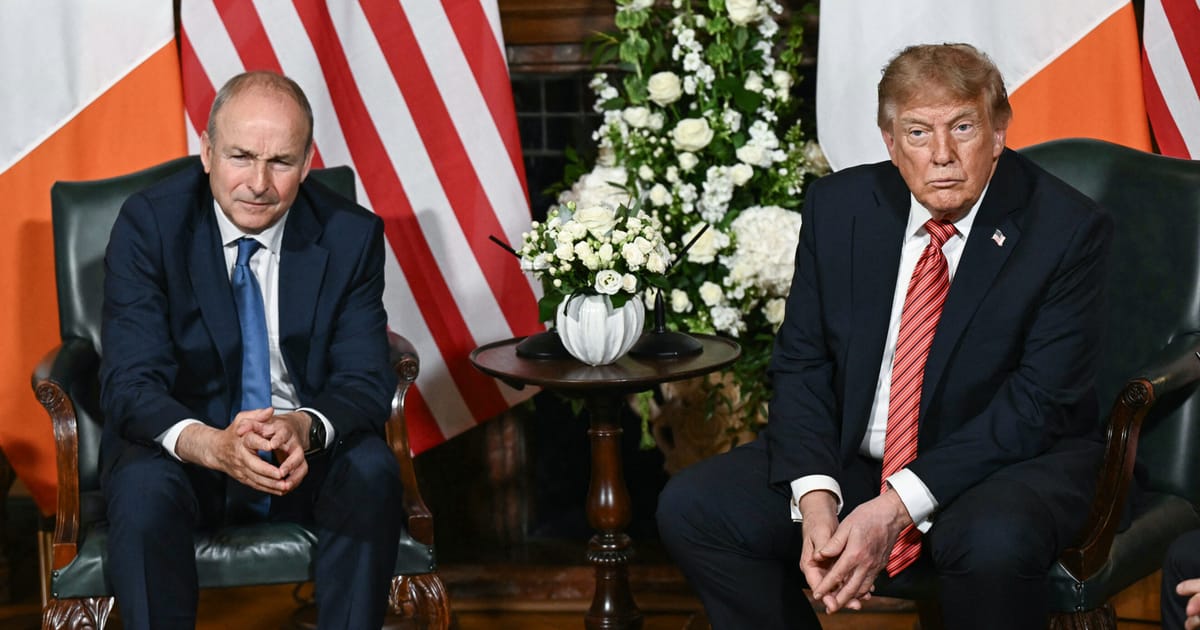
The Irish republicans of Sinn Féin, which long backed Irish Republican Army violence aimed at destabilizing Northern Ireland and ending the island’s partition, seized on Trump’s words to shift political pressure back on Martin, Ireland’s prime minister.
Sinn Féin today leads the cross-community government in Northern Ireland created by the IRA’s 1997 cease-fire and the 1998 peace deal. But south of the border, it remains the main opposition party — the primary parliamentary thorn in Martin’s side.
“The conversation on Irish unity has shifted, and the onus is on the taoiseach to begin planning,” said Sinn Féin leader Mary Lou McDonald, appealing to Martin to push much harder on the issue. She lambasted Trump as a warmonger who “must stop arming Israel” and “must stop facilitating the genocide of Palestinian people.”
Sinn Féin’s moderate competition for Irish nationalist votes in Northern Ireland, the Social Democratic and Labour Party, offered a far more light-hearted welcome for Trump’s apparent endorsement of their position. SDLP leader Claire Hanna drew gasps and whoops from the audience at her party’s annual conference in Belfast when she declared: “Donald Trump in the last hour has announced that he is in favor of a united Ireland.”
“Turns out he’s not as orange as he looks,” she said, referencing Trump’s facial make-up as well as the main Protestant fraternal organization in Northern Ireland, the Orange Order.
Trump quickly acknowledged that his Irish unity remarks would raise eyebrows and make headlines.