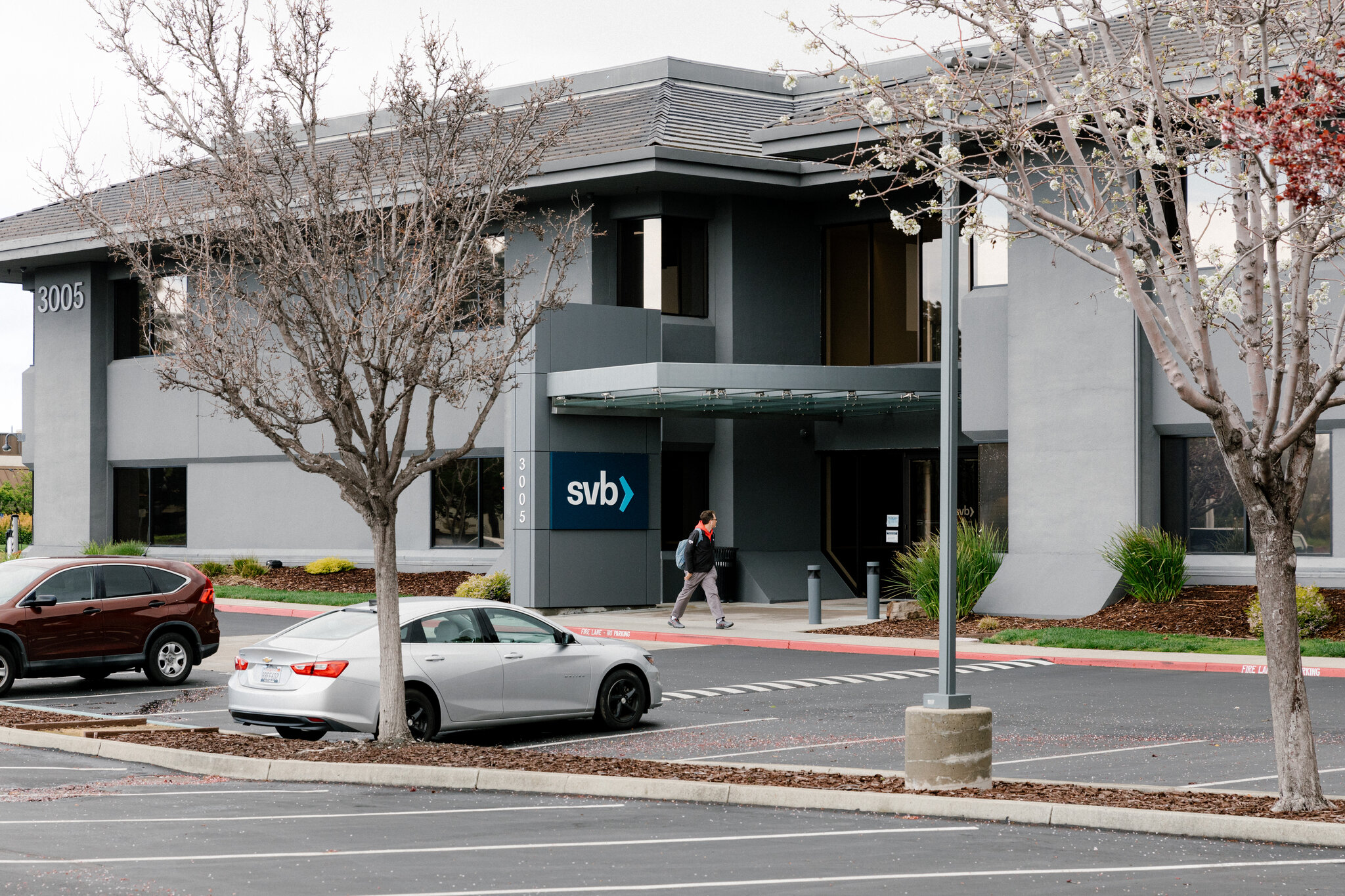
Printed murals are turning up in cafés, gyms and retail interiors. The machines that put them there are quietly becoming an equipment category of their own.
The mural behind the counter of your local coffee shop probably was not painted. Somewhere in the last few years, a machine roughly the size of a filing cabinet was wheeled in on castors, parked against the wall, and left to lay down ink for an afternoon. When it finished, someone rolled it back out through the front door.
That machine is a UV wall printer, and the businesses buying them are not art studios. They are print shops, signage firms and small advertising agencies looking for something to sell that their competitors cannot easily copy. What has changed is not the technology, which has existed in some form for over a decade. What has changed is that the machines got portable enough, and cheap enough to run, that a two-person print business can justify one.
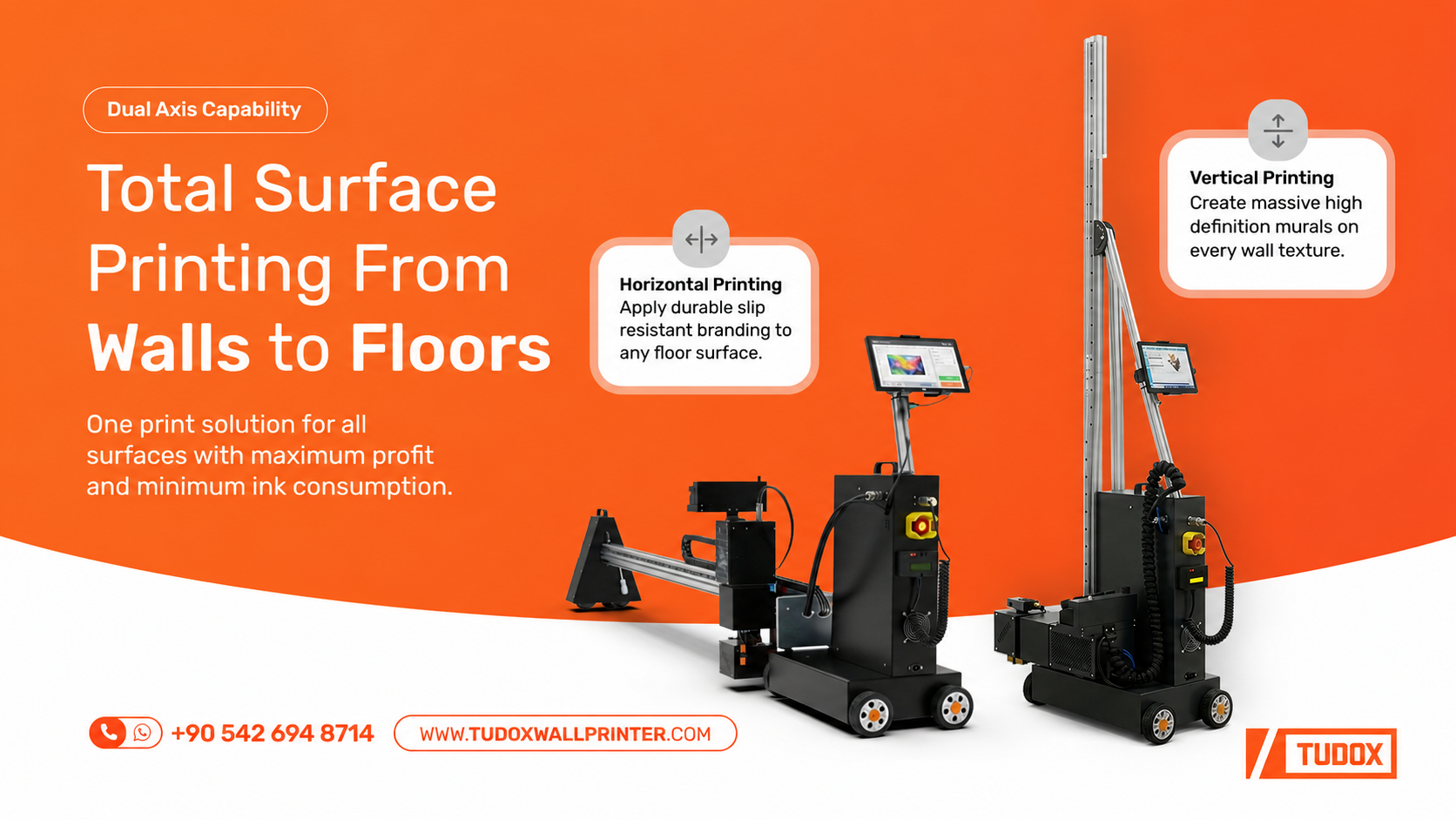
One of the companies betting on that shift sits in Çayırova, an industrial district in Kocaeli, in the corridor of factories and workshops that runs east from Istanbul. It trades as Tudox Wall Printer and is registered as Tudox Makina ve Hidrolik Pnömatik Sistemler Sanayi Ticaret Limited Şirketi, a name that points at machinery and hydraulic pneumatic systems rather than at printing. It builds four UV wall printers, the TDX3000, TDXW, TDXECO and TDX PRO, and has spent the last three years trying to sell them outside Türkiye.
The specifications are modest enough to be believable. The machines lay UV-curable ink directly onto a vertical surface at two to six square metres an hour, depending on the model and the job. CMYK is standard, with white ink on the compatible models. They will print onto glass, wood, metal, concrete, ceramic, brick, stone and plaster as well as ordinary painted wall, and the same chassis can be reconfigured to print flat onto a floor.
That last detail matters more than it sounds. Floors are where the alternative is vinyl, which has to be measured, cut, laid, and eventually pulled up and replaced. Printing straight onto the surface removes an entire supply chain from the job.
The economics of a square metre
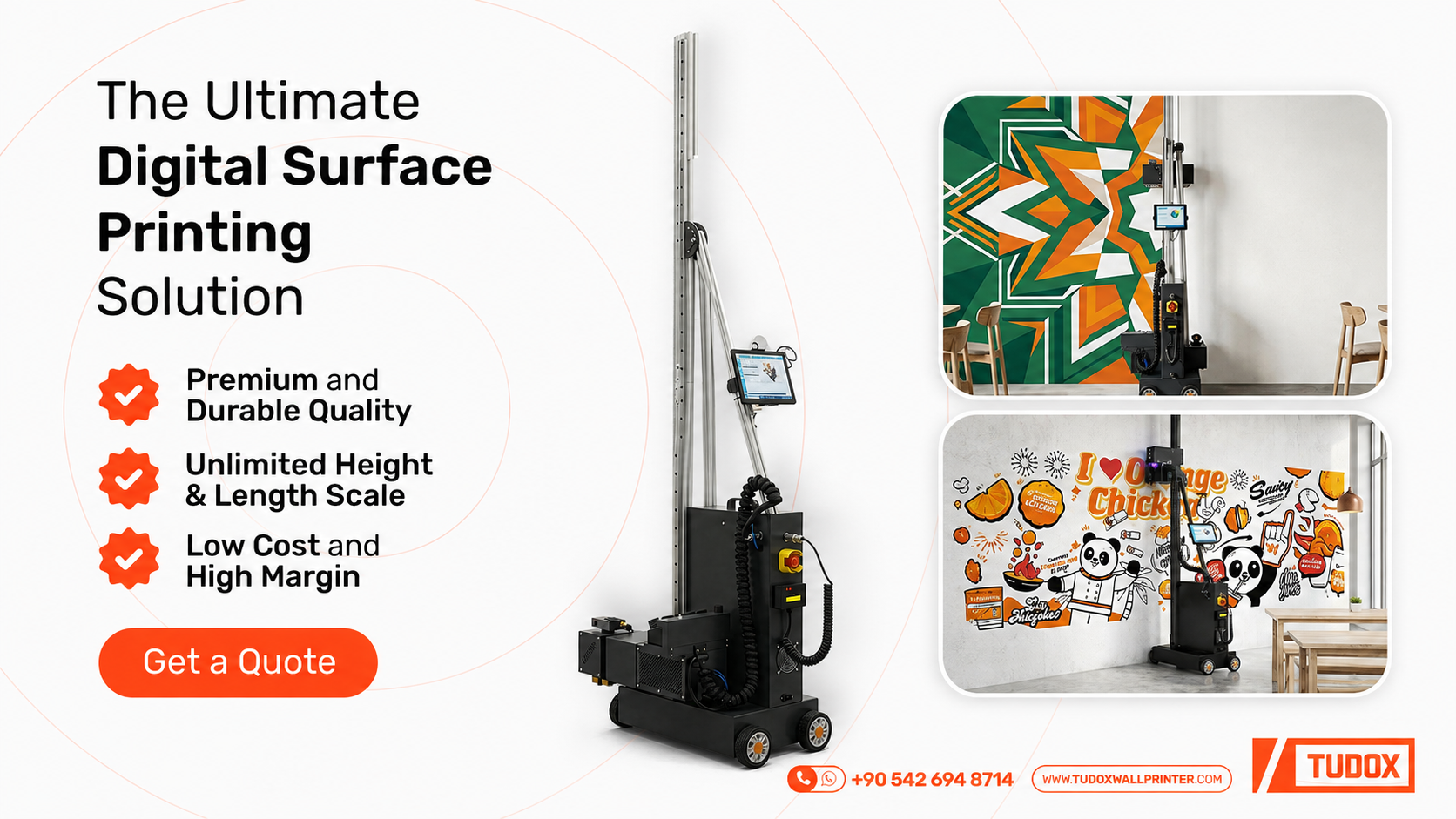
Throughput is the number buyers fixate on, and for good reason. It is what decides whether a mural is a quotable job or an expensive favour. A machine that covers a café wall inside a working day is a different business proposition from one that ties up a technician for a week, and at two to six square metres an hour the arithmetic starts to work for a small operator with one machine and one van.
The wider appeal has less to do with the printing than with what disappears from the job. There is no substrate to hang and no seams to align. Nobody books a scaffolding crew for a fortnight. For a print shop already quoting signage and vehicle wraps, wall and floor graphics slot onto the price list without new premises or new staff.
“Most of our customers are not artists,” said Emrah Pürtaş of Tudox. “They run print shops, signage firms and small advertising businesses, and they want a service they can sell at a sensible price without hiring a painter. What we are really trying to do is make this technology accessible and portable enough that it becomes commercially useful to a small operator, not just to a large production house.”
Getting the machines out of Türkiye
The company appeared on Turkish B2B exporter directories in 2022 and shows up in customs records from May 2023 onward, shipping to Bosnia and Herzegovina among other destinations. In 2023 it took a stand at Sign Istanbul, the printing trade fair held at Tüyap, and posted footage from the floor to its own channel. In February 2025 it sent a wall printer out of Istanbul to the New York area, a single crate weighing 200 kilograms. None of this is large. It is the unglamorous shape of an equipment manufacturer working out whether it can sell abroad at all.
Selling industrial equipment across borders is a support problem long before it is a sales problem. A print shop in another country with a stalled printer and a client waiting is not reassured by a warranty document, and the traditional answer, a local dealer network, is expensive to build and slow to reach useful density.
Tudox says it went at this directly, building a technical support system that lets its own engineers diagnose and assist remotely rather than routing every fault through an intermediary. The company also provides training and technical guidance with the machines. Whether that scales is the open question for any manufacturer of its size, and it is the thing a prospective buyer three time zones away should be asking about before they ask about print resolution.
The company describes a deliberate decision not to compete on price against larger manufacturers, and to compete instead on reliability, incremental engineering improvement and the length of the customer relationship. It says its machines have been refined through feedback from customers already running them commercially. Tudox does not publish figures for units shipped or markets served, which is unremarkable for a private manufacturer of its size and does leave the scale of the international business unclear.
Most of what it does publish is video. The company runs a YouTube channel with 28 videos and just under two thousand subscribers, and an Instagram account with around six thousand followers across 258 posts, most of it machines printing in real time. For a product that has to be watched working before anyone believes the speed claim, that is a rational place to put the marketing budget, and it is a long way from how industrial equipment was sold a decade ago.
Two very different customers
The buyer base is split in a way that shapes everything about how a company like this has to operate. Tudox describes its customers as printing businesses, advertising companies, interior designers and entrepreneurs, and those last two words carry most of the risk. An established print operation adding a line already has technicians, a client list and a sense of what a job should cost. Someone buying their first machine to start a business has none of that, and needs a supplier willing to spend months on the phone.
Serving both from a single factory is a strain, and it is the strain that tends to decide which specialist manufacturers survive a category as it matures.
“Innovation on its own is not enough,” Pürtaş said. “You have to listen closely to customers, solve problems that are actually in front of them, and build trust slowly. Setbacks are part of that. We would rather help someone build a business that is still running in five years than sell them a machine this month.”
The stated ambition is to widen the distributor and service network, keep developing the range, and become a reference name in wall printing internationally. Tudox frames that as an argument about access rather than a sales target, saying its aim is to put professional equipment within reach of operators who could not previously justify the cost.
That is a reasonable bet, and it is not a safe one. Categories like this tend to commoditise from below, and the manufacturers that hold their ground are usually the ones whose customers stayed in business long enough to buy a second machine. Specifications for the four models are published at tudoxwallprinter.com.