The Outcomes Most Organisations Never Measure
by Business Analysis,
This article is the third in our series exploring the real value of accurate business analysis and the impact it has on organisational performance, decision-making, and transformation success.
In our first article, The Cost of ‘Alternative Facts’ in Business Analysis, we explored how organisations often mistake assumptions, preferences, and stakeholder opinions for genuine business needs.
In our second article, The Hidden Cost of Assumption-Led Transformation, we examined how those assumptions become embedded in transformation programs, creating organisational debt, rework, unrealised benefits, and unnecessary investment.
The conversation so far has focused largely on risk, waste, and cost avoidance. But that only tells part of the story. Because while effective business analysis certainly helps organisations avoid costly mistakes, its greatest value is not found in what it prevents. Its greatest value is found in what it creates. Unfortunately, many organisations never fully recognise this.
Business analysis is often viewed through the lens of deliverables, e.g. requirements documents, process maps, stakeholder workshops, business cases, and solution assessments. Yet none of those artefacts represents the actual value of business analysis; they are simply outputs. The real value lies in the outcomes those outputs enable, and those outcomes can fundamentally transform how organisations operate.
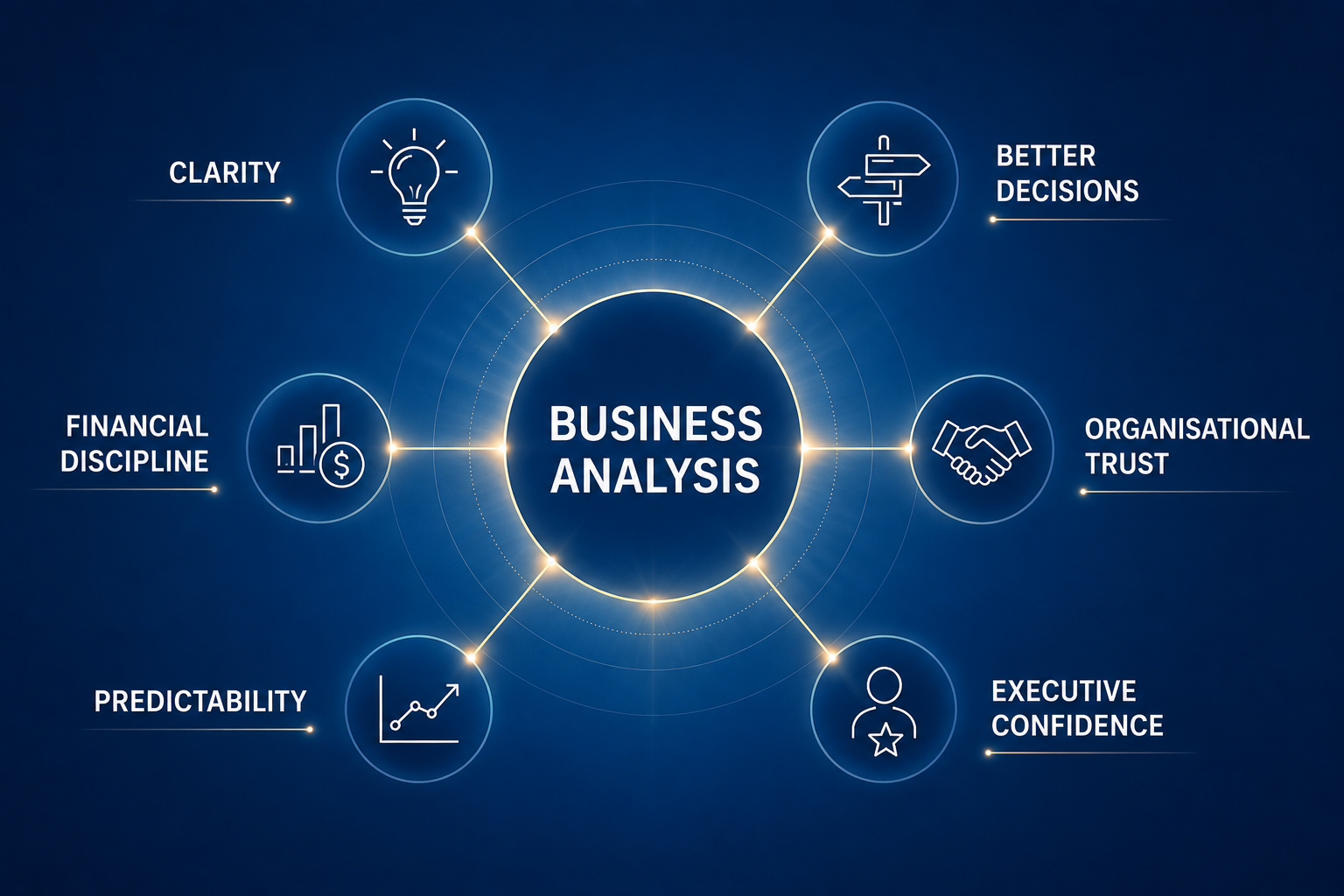
Accurate Business Analysis Creates Clarity
Most organisational challenges are not caused by a lack of effort; they are caused by a lack of clarity. Teams work hard, projects move quickly, and stakeholders remain engaged. Yet initiatives still struggle because different parts of the organisation are operating from different interpretations of reality. One team believes the problem is technology, another believes it is process, leadership believes it is capability, and operations believes it is resourcing. Without a clear understanding of the actual problem, alignment becomes almost impossible.
Accurate business analysis creates clarity by establishing a shared understanding of:
- the problem being solved
- the desired outcomes
- current operational realities
- constraints and dependencies
- success measures
- stakeholder expectations
When everyone is working from the same understanding, decision-making accelerates and organisational friction decreases. Clarity reduces noise, and organisations that reduce noise make better decisions.
Accurate Business Analysis Creates Better Decisions
Every significant organisational outcome is ultimately the result of a decision. Investment decisions, technology decisions, operational decisions, strategic decisions. The quality of those decisions depends entirely on the quality of the information available. Yet many leaders are forced to make decisions using incomplete, conflicting, or politically filtered information. This creates uncertainty. Business analysis helps remove that uncertainty by replacing assumptions with evidence. When leaders have access to dependable information, their priorities become clearer. The risks become visible. The trade-offs become easier to evaluate. The investments become more defensible. and ultimately, the outcomes become more predictable The result is not simply better projects, it is better organisational decision-making. And over time, better decisions compound into better organisational performance.
Accurate Business Analysis Creates Financial Discipline
One of the least appreciated outcomes of effective business analysis is improved financial performance. Not because business analysis directly generates revenue, but because it helps organisations invest more intelligently. Every year, organisations allocate significant budgets to initiatives intended to improve performance, reduce costs, or support strategic objectives. The challenge is that many investments are approved before there is sufficient evidence to prove they will deliver value. Business analysis introduces discipline into that process. It helps organisations answer critical questions:
- What problem are we solving?
- What measurable outcome are we expecting?
- How will success be assessed?
- What evidence supports the proposed investment?
- Are there alternative approaches available?
The result is stronger investment decisions and better resource allocation. In many cases, the greatest return on investment is not the project that proceeds, but the project that never starts because analysis revealed it was unnecessary. See this case study for a great example of such.
Accurate Business Analysis Creates Organisational Trust
Trust is rarely discussed as a business outcome, yet it is one of the most valuable assets an organisation can possess. When reporting is inconsistent, priorities constantly change, and projects repeatedly fail to deliver expected outcomes, trust begins to erode. Leadership loses confidence in forecasts, and teams lose confidence in priorities. Stakeholders eventually lose confidence in transformations, and ultimately, scepticism can spread throughout the organisation.
Accurate business analysis helps rebuild trust by creating transparency. Problems become definable and measurable. Assumptions are clear, decisions are traceable back to the problems they solve, and accountability is placed on outcomes. When stakeholders can see the connection between the evidence, the decisions, and the results, confidence grows. Organisations that can trust their information move faster than organisations that constantly question it.
Accurate Business Analysis Creates Predictability
Transformation is often described as complex and uncertain. While some uncertainty is unavoidable, much of the unpredictability experienced by organisations is self-inflicted. Projects frequently encounter surprises because critical information was never discovered. The scope expands because assumptions were never validated. Benefits fail to materialise because expected outcomes were never properly defined. Business analysis helps reduce this uncertainty, not by eliminating change, but by improving visibility.
When organisations understand their current state, desired future state, dependencies, risks, and constraints, transformation becomes significantly more predictable. Predictability improves planning, which improves execution, which improves outcomes. The relationship between these is simple yet valuable.
Accurate Business Analysis Creates Executive Confidence
Perhaps the most significant outcome of all is executive confidence. Modern leaders operate in increasingly complex environments. Technology changes rapidly, customer expectations evolve continuously, and investment decisions carry significant risk.
At the same time, executives are often presented with conflicting information from multiple sources. This creates decision fatigue. Leaders spend considerable time trying to determine which information can be trusted. Accurate business analysis changes this dynamic. It provides leaders with dependable information, validated assumptions, measurable impacts, and evidence-based recommendations.
As a result, executives move from reacting to issues to making informed decisions. From resolving conflicting narratives to prioritising with confidence. From defending investment decisions to governing effectively. From managing uncertainty to leading strategically. This transformation is rarely measured, yet it may be one of the most valuable outcomes of business analysis. Because confident leadership produces confident organisations.
What Great Business Analysis Really Delivers
When organisations discuss business analysis, they often focus on the activities. Workshops, requirements, documentation, process models, business cases. But these are not the end goal; they are simply the mechanisms used to create something much more valuable – clarity. Clarity creates confidence, which enables alignment, builds trust, drives predictability, supports financial discipline, and aids better decisions. These are the outcomes that accurate business analysis produces, and they determine whether transformation succeeds or fails. Because ultimately, great business analysis is not about documenting reality, it is about helping organisations understand reality well enough to change it successfully.
Next in the Series
In the next article, The ROI of Dependable Information, we explore how accurate business analysis creates measurable financial value through better investment decisions, cost avoidance, reduced waste, improved governance, and stronger strategic outcomes.
Because some of the most valuable returns in business are generated not by what organisations do, but by the costly mistakes they avoid making in the first place.