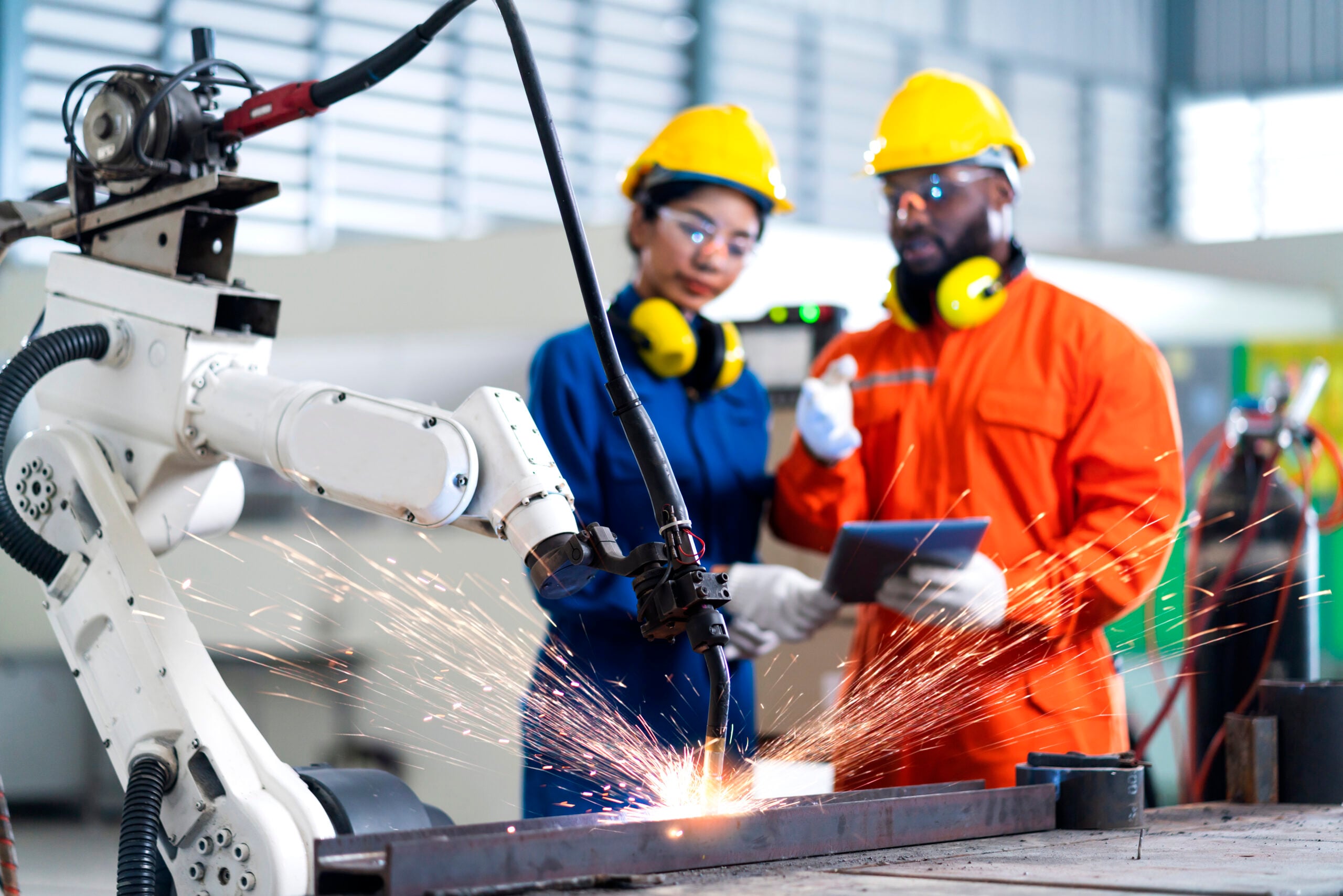
Two welders retired inside twelve months. Two decades of feel for heat and puddle left with them. Four hundred welded frames a month kept coming anyway. That was the arithmetic at a 60-person equipment assembler in the upper Midwest running one shift, where a frame that used to pass inspection on the first look started coming back to the grinding bench week after week. The plain version of the argument is this. When the people who made a weld repeatable retire, moving the repetitive assemblies to a partner running robotic welding cells restores uniform weld profiles and consistent penetration faster than a hiring plan that is not going to land.
Skill Left The Building Before The Work Did
The retirements were not a surprise. Both men had talked about a lake cabin for years, and there was a succession plan in a binder. What the binder could not carry was the thousand small corrections a 30-year welder makes without thinking, the slight change in travel speed on a thin gusset, the sense that a fixture has drifted a sixteenth. Experience does not hand over its notes on the way out the door. The two replacements hired that fall were certified and willing, and by every account good hires. They were also nine weeks into a job the retirees had held for three decades.
A shop foreman two counties over patched the same hole by keeping one retiree on Saturdays at time and a half for the hard seams. That held until the man moved to Arizona in April. Stopgaps like that are everywhere in fabrication, and they share one expiration date, which is the day the person you are leaning on decides he is finished.
Rework Hides Inside Labor Not Scrap
The frames still shipped. That is what kept the problem invisible for two quarters. Nothing went in the dumpster, so the scrap report stayed flat while the grinding bench quietly gained a second stool. In practice this typically means the money lands in overtime and in a ship date that slides a day and a half, not in any quality number anyone reviews on Monday morning.
Rework rarely announces itself as a quality failure. It shows up as labor hours nobody budgeted.
The supply side of this is not a local story. A July 2026 welding career outlook published by Tidewater Tech Trades reported that 21% of the U.S. welding workforce is over age 55, better than 157,000 experienced professionals at or past retirement age. Treat that as a decade-long supply problem rather than one bad hiring season. Waiting it out is not a plan, because the wave has not crested.
Automated Cells Restored Unit To Unit Consistency
A welding cell does not out-skill a good welder. It out-repeats one. Travel speed, torch angle, heat input, and dwell land the same on frame 12 as on frame 380, and that repeatability is precisely the variable that walked out the door with the retirements. The plant moved its three highest-volume frames to an outside shop running automated cells and kept the low-volume custom work and anything needing a one-off fixture in house for its own welders. First-pass yield on those three frames stopped drifting inside the first full production run.
What nobody at that plant can tell you is how much of the rework was the new welders and how much was fixture wear that had gone unmeasured for six years. Both were true at once, and both showed up in the same month. I have never seen a shop separate the two cleanly after the fact, and I am not going to pretend the split is knowable.
What To Ask A Fabrication Partner Early
The wrong first question is price per part. Ask instead about consistency evidence and about who owns the fixture, because those two answers predict whether month three looks anything like month one. A partner that inspects at every production stage rather than only at the end will say so plainly and will show you where the checks sit.
- How do you prove unit to unit weld consistency, and can I see inspection records from a run like mine? A good answer names the stage checks and the measuring method, not just a final visual look.
- Who builds and owns the fixture, and what happens to my lead time when it needs rework? A good answer gives a number of days and says plainly who pays for it.
- What is your minimum run size before an automated cell makes sense for my part? A good answer is a specific quantity, such as 50 pieces per release.
- Which of my parts would you tell me not to send you? A partner who can name one has actually read the prints.
Expect Months Not Weeks To Stabilize
The first two weeks are prints and paperwork, and they run slower than anyone expects, because tolerances that lived in a welder’s head have to be written down. Somewhere in month two the first production run comes back and the argument shifts from whether the weld is right to whether the fixture matches the drawing. By month four the reorder cadence settles and the grinding bench goes back to one stool. Nine months in, that plant was running roughly 400 frames a month again with two welders on the floor instead of four.
None of this solves a labor shortage, and anyone selling it that way is overselling. What robotic welding buys a plant that just lost thirty years of experience is the portion of the job that never needed judgment, done the same way every time, which frees the people still on the floor for the work that does need it. That trade is available now, on a purchase order, in a market where the certified welder you want to hire already has three other offers.